
 |
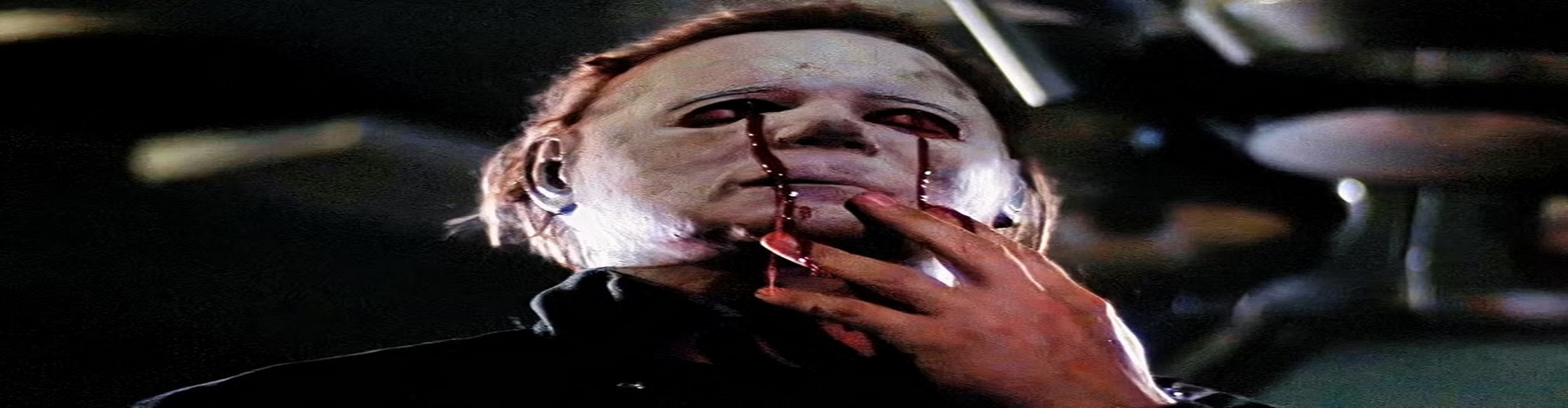
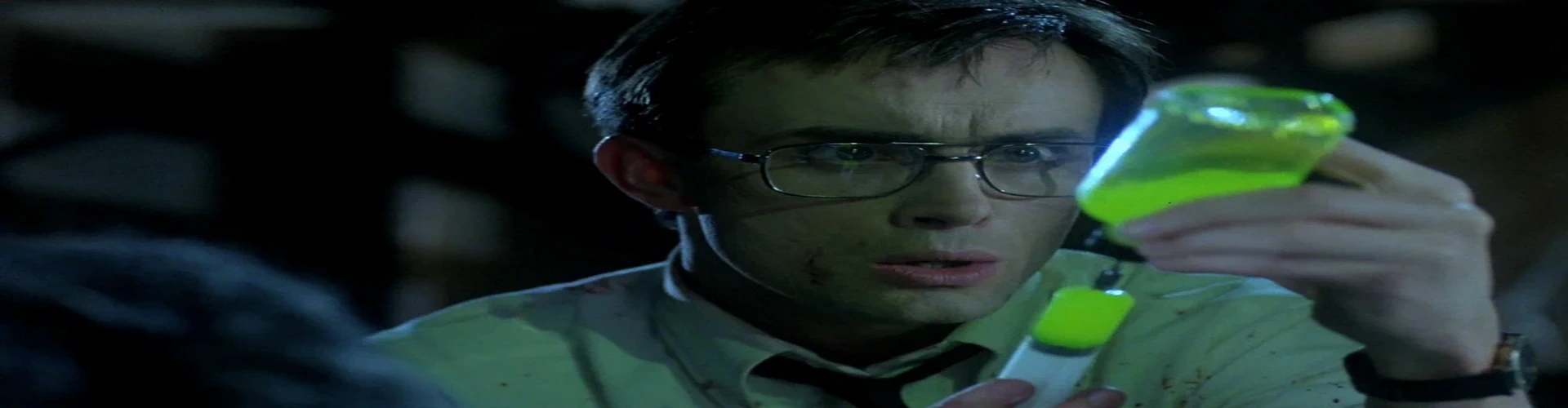
| Blind boogeyman. Credit: Universal Pictures |
The final moments of John Carpenter’s Halloween (1978) made for the perfect end to the story of Michael Myers, Laurie Strode, and Dr. Samuel Loomis. After Loomis fires six shots into Michael, sending him falling from the balcony of the Doyle house where Laurie was babysitting little Tommy, a lingering long shot shows Michael’s supposedly dead body laid out on the front lawn. Laurie says, “It was the Boogeyman”, to which Loomis replies, “As a matter of fact, it was.” When Loomis looks down, he sees that Michael has disappeared. While his initial reaction is one of shock, his expression shifts as he looks up, hardening into a look of expectation—as if he knew this would happen. The camera then transitions to a montage of locations Michael visited throughout the night, accompanied by the sound of his heavy breathing behind the mask, before closing on the Myers house. He is still out there, and evil could be anywhere.
The subtext represents the idea that no matter what we do, we cannot destroy evil; it inevitably returns. Michael is the embodiment of this concept—the personification of an un-killable malice—and his mask itself—The Shape—symbolises pure malevolence. Its design is subtly unsettling, projecting our own fears onto its features. This mimics how Loomis describes Michael: “…blank, pale, emotionless.” Ultimately, these elements reinforce a supernatural theme, framing Michael not just as a man, but also as an ominous force of nature. We genuinely believe this unstoppable killing machine, although born of this world, is no longer part of it.
This ingenious, ambiguous ending has been set up from the outset. Over the course of the proceedings, Michael's psychiatrist, Loomis, in his deeply obsessive pursuit of him, constantly warns the other characters of the extreme danger Michael poses. Smith’s Grove officials and Haddonfield’s Sheriff Brackett believe none of it. He delivers highly memorable monologues about how Michael is pure evil and the devil incarnate. Loomis is strong in his conviction that Michael is something other than a man, which serves as a narrative device to help turn Michael into more than just another maniac killer on the loose. This is perfectly supplemented by young Tommy Doyle believing the Boogeyman is coming for him this Halloween night—and Michael realises his belief.
While this climax was left open-ended to invite us to interpret rather than to serve as a gateway for a sequel, commercial reality soon took over. Because Halloween became the most successful independent film of its time—and because horror proved to be a massively profitable genre at the turn of the 1980s—Michael Myers was bound to return. Friday the 13th (1980), heavily inspired by Halloween, added explicit gore and other tropes to the established template, opening the ‘bloodgates’ for a deluge of low-budget imitators that slashed through the box office. With the slasher sub-genre now in full machete swing, it was time for The Shape to return and show how it was truly done. Fittingly, the sequel to the film that birthed an entire cinematic movement was released in 1981, the peak year of the first slasher cycle's saturation. But its return came with several caveats.
 |
| Laurie Strode (Jamie Lee Curtis) and Dr. Samuel Loomis (Donald Pleasence) face Michael Myers once again on the same terrifying night. Credit: Universal Pictures |
I actually saw Halloween II for the first time before I had even seen the original. At some point in the 1990s, not long after I became a serious film and horror fan, a classmate lent me the sequel on an old videotape he had taken from his father’s collection. It was a bootleg copy, which his father must have owned since the movie's UK theatrical run. The BBFC 'X' certificate card appeared right before the start of this uncut version. This rating was replaced by the '18' certificate in 1982 when Halloween II hit the UK home video rental market on VHS and Betamax via MCA/Universal Home Video. For that release, 17 seconds were trimmed from Pamela Susan Shoop’s nudity and her character Nurse Karen Bailey’s subsequent murder—Michael Myers drowns and scalds her in a hospital hydrotherapy tub. This missing footage was finally restored for the 2002 DVD release. It is visually striking and harrowing imagery that has stayed with me ever since. The darkened grain of this bootleg copy, recorded on an old dirty VHS tape, only added to the film’s dark atmosphere. I loved it.
Halloween II opens with the sound of “Mr. Sandman” by The Chordettes. This cheerfully innocent song is turned into something extremely creepy. The track is highly significant, contrasting sharply with Michael Myers' stalking of Laurie Strode (Jamie Lee Curtis) while she is heavily sedated in Haddonfield Memorial Hospital. This plot device makes her more vulnerable—a woozy sitting duck to the present danger of the malevolent Michael, who bumps off the hospital staff one by one while working his way toward her as she drifts in and out of consciousness. Unfortunately, being stuck in bed gives Curtis little to do for the first hour. However, this is made up for in the thrilling final third as Michael pursues Laurie while she is doped up and nursing a fractured ankle from the events of the previous film.
When “Mr. Sandman” fades out, there is a recap of the original's climax. Then Loomis (Donald Pleasence, 1919–1995) goes down to investigate the disappearance of Michael, and a next-door neighbour comes out to see what all the commotion is about. Here, we are treated to some immensely quotable dialogue in an incredibly cool scene:
Neighbour: What’s going on out here?
Loomis: Call the police! Tell the sheriff I shot him!
Neighbour: Who?
Loomis: Tell him he’s still on the loose!
Neighbour: Is this some kind of joke? I’ve been trick-or-treated to death tonight.
Loomis: You don’t know what death is!
Loomis then runs off, and the scene segues smoothly into the title sequence accompanied by a version of John Carpenter’s iconic theme, which he co-composed with Alan Howarth. The familiar piano melody is upped in tempo and played on a synthesizer, backed by the ominous, heavy blasts of an organ. This heavily stylised, exhilarating, Gothic-infused variation stands as one of the most underrated compositions in cinematic horror history.
The first movie’s title sequence featured a jack-o'-lantern against a black backdrop—as the camera slowly zoomed in on its left eye, a hidden skull was revealed just as the candle inside dimmed and went out. In this sequel, the camera slowly moves in on the entirety of the jack-o'-lantern. As the candlelight inside begins to flicker, the pumpkin dramatically rips apart down the middle to reveal a skull's full visage. The camera then continues to close in on the right eye socket until it plunges completely inside. This is deeply chilling imagery.
As Halloween II takes place right after the previous events, set on the exact same night, this makes it more of a companion piece than a standard sequel. Because it functions as a direct continuation, its tagline promised “… More of the Night He Came Home.” To maintain continuity, director Rick Rosenthal is dedicated to carrying over the original’s specific stylistic traits.
In the opening post-title sequence, we see Michael Myers creep around the back alleys through his POV, much like the beginning of the last film.
He sees Loomis picked up by Sheriff Brackett (Charles Cyphers, 1939–2024) in his patrol car, as Loomis shouts his now-famous line, “I shot him six times!”
Michael then comes across the back of a house where the kitchen is situated. Peering through the kitchen window, he watches an elderly woman preparing a sandwich for her husband, who is asleep in an armchair in front of a TV in the living area. The camera then shifts away from this voyeurism, moving into the interior of the house as the woman walks away from the kitchen to see why her other half is not answering her. On their television, the Halloween horror movie marathon carried over from the original is playing. Instead of The Thing from Another World (1951), the channel is now showing Night of the Living Dead (1968). The camera then returns to Michael’s perspective as a breaking news bulletin airs on the TV, reporting the three murders committed in the Wallaces' house, where Laurie’s friend Annie was babysitting little Lindsey. Michael enters the house through the kitchen and picks up the knife the old woman was using to make the sandwich. This shot looks just like when the young Michael takes a butcher's knife from the kitchen drawer in the opening of the first film.
It is from here, though, that we start to see the distinct differences. Michael makes his way to a neighbouring house where a young woman is inside. This first killing—featuring a knife driven through her chest—delivers the first bit of blood seen since the very beginning of its predecessor, which depicted Michael’s stabbing of his older sister, Judith. This marks the first of eight graphically gruesome set-pieces.
This scene is also the start of the sequel’s problems. This was an unnecessary, gratuitous set-piece because it does not fit Michael Myers’ M.O.—he tends to only kill those directly in his way, and this young woman clearly was not. This sequence, like the other horrific sequenes, was completely absent from the original cut.
 |
| Michael Myers (Dick Warlock) means business. Credit: Universal Pictures |
Rick Rosenthal wanted to make something closer to the spirit of John Carpenter’s original work, relying mostly on mood, deliberate pacing, suspense, and tension. However, when he delivered his rough cut, Carpenter knew it was not what audiences wanted to see in this new era of bloodletting "money shots". The production had to compete with explicit offerings released in the same year, such as My Bloody Valentine, Friday the 13th Part 2, The Burning, and The Prowler. The ultimate irony is that while the first Halloween spawned the slasher sub-genre, it was now out of place within it. Forced to deliver the gory goods, the producer, now acting as a director, shot this additional material at night behind Rosenthal’s back to give the movie the shocks it needed to draw its target audience.
John Carpenter made a couple of mistakes cutting his version that ruin the timeline. The placing of the aforementioned breaking TV news bulletin, reporting the dead bodies at the Wallaces’ house, is literally just minutes after Loomis shot Michael—meaning the discovery had not actually happened yet. Another continuity error Carpenter created was omitting the scene where Michael cuts the hospital’s power and the emergency generator starts up. This explains the building’s dark setting from the halfway mark onwards.
The TV version is much closer to Rick Rosenthal’s originally intended vision. It puts everything back in order—for instance, we hear the news report after the bodies are found in the Wallaces’ house. There are no gory kills, and this includes Michael leaving the young woman in the house alone. There is more character development. There is a lot more of the town of Haddonfield falling into panic due to the events of the last film—this backdrop of increasing community fear makes this sequel stand out from the slasher pack that usually exists in a vacuum.
But the worst offence John Carpenter committed was at the writing stage, with the sibling revelation that creates massive plot holes in the original. After watching Halloween II multiple times on that old dirty bootleg videotape, I obviously needed to see the first movie, so I bought a VHS copy with a crappy pan-and-scan transfer on the tacky, gold-covered 4Front Video budget imprint from PolyGram Video. Even then, when I was a know-nothing kid, it became abundantly clear that Michael Myers and Laurie Strode were not initially intended to be brother and sister.
 |
| Laurie gets away by the skin of her teeth. Credit: Universal Pictures |
In Halloween, Laurie goes to the empty Myers house on the way to school to drop off the keys for her estate agent father. She is accompanied by Tommy Doyle, whom she meets along the way and is babysitting that night. Michael sees them from inside and fixates not just on Laurie, but on Tommy as well. While it is feasible that Michael sees a resemblance to his sister Judith in Laurie, and sees a reflection of his own boyhood self in Tommy, John Carpenter is actually establishing that even the most mundane daily routines in our lives can land us in mortal danger. This is frightening in itself.
When Annie shouts out something rude to Michael as he stalks Laurie from the stolen Smith’s Grove Sanitarium station wagon, he changes his focus to Annie for the next half-hour of the runtime, with the sole exception of stalking Laurie in her own backyard. At the start of the final third, after murdering Annie, Laurie’s other friend Lynda, and her boyfriend Bob at the Wallaces’ house where Annie was babysitting, Michael turns his attention to Laurie. However, this only happens when she leaves the Doyle house to walk over to the Wallaces’ house to investigate, following a phone conversation with Lynda in which Laurie hears her being strangled before the line goes dead.
Laurie eventually discovers Annie’s body laid out on a bed in front of Judith Myers’ tombstone. If Laurie and Michael are truly siblings, then why did he not reserve this specific spotlight for her? Instead, he chose one of Laurie’s friends who merely insulted him. Michael followed Annie to the Wallaces’ house to kill her for this reason alone. It does not sound like the behaviour of a psychopathic killer focused solely on murdering his remaining sister, especially when she is easily reachable just across the street. He knows she is over at the Doyle house, yet he does not once go over there during the entire night.
These are the acts of a deranged lunatic wanting to relive his past crime over and over again by using whoever crosses his path to serve his homicidal repetition. If Laurie had never gone over to the Wallaces’ house, she could well have been spared Michael’s knife attack, and he could have simply found another victim to stalk and murder on his homecoming night.
One of the scariest elements of Halloween is the antagonist’s total lack of motivation—there is very little backstory and exposition given to Michael Myers. One Halloween night, a six-year-old boy from a middle-class suburban family decided, for no reason whatsoever, to stab his older sister to death. Fifteen years later, he awakens from a state of catatonia, escapes incarceration from a mental institution, and returns to his small hometown to relive his crime. By doing a simple everyday favour for her father on that fateful day, Laurie became just one of Michael’s arbitrary targets in his quest to rekindle that specific moment in his life, which remains his sole driving force. Laurie’s friends then come to his attention while he is stalking her, giving him the opportunity to relive his original crime repeatedly.
In Halloween II, when Michael bumps into a teenager carrying a boombox and hears the radio news report stating that Laurie has been taken to Haddonfield Memorial Hospital, this was already a perfectly good motivation: to finish the job by killing the one who got away. This fits Michael’s character flawlessly, so it would have been more than sufficient. He is simply pure evil—he kills because that is what he does. Doing away with this ambiguity by giving a concrete reason for his actions ultimately demystifies an enigmatic, malevolent entity.
 |
| Michael Myers digs the sound coming from this teen's boombox. Credit: Universal Pictures |
Dick Warlock as Michael Myers moves much slower, and his body movements are far stiffer, than Nick Castle’s performance in the first film, making this killing machine more robotic. Yet Warlock is utterly convincing as a devil incarnate. The same original William Shatner prop was used for the mask, but it had visibly deteriorated over time.
Returning cinematographer Dean Cundey shoots Michael in a way that brings him right out into the light, employing none of the previous camera trickery where he shot him on the fringes of the frame, existing as a visual enigma where we question whether Laurie is actually seeing him. Because we already know from that movie's conclusion that Michael must be something other than human and is near-indestructible, the same aesthetic need not apply here.
It is incredibly strange that the hospital is nearly empty. There is only a handful of staff and there are zero patients except for Laurie, even though there is inexplicably a nursery full of newborn babies. Every time I watch Halloween II, this logical flaw bugs me, but it serves a distinct artistic purpose. While this setting is not as visually rewarding as the last film’s wide-open suburban spaces, this standard, remote setting for a slasher provides an overwhelming feeling of isolation. The eerie confinements of the building’s dark hallways and rooms in this perpetual night setting, long shots of Michael Myers making his way through the corridors, and the security cameras capturing his movements on the monitors all make for a claustrophobic and creepy atmosphere.
 |
| You wouldn't want to bump into him alone in a dark hallway. Credit: Universal Pictures |
Inferior to the original, yes, but taken on its own merits, Halloween II stands out as an extremely effective slasher horror from the sub-genre’s early 1980s Golden Age, a time when a new entry opened in cinemas almost every weekend. Having watched this sequel first, I credit its rock-solid, workmanlike approach and genuinely great moments for cementing my lifelong horror fandom. While my nostalgia undoubtedly plays a significant part here, the fact that I can acknowledge its objective flaws, while still finding it highly entertaining, makes for a valid argument: this is a good, even if not quite as good, follow-up to a masterclass piece of filmmaking.
© 2026 Dave J. Wilson. All rights reserved.


