
 |
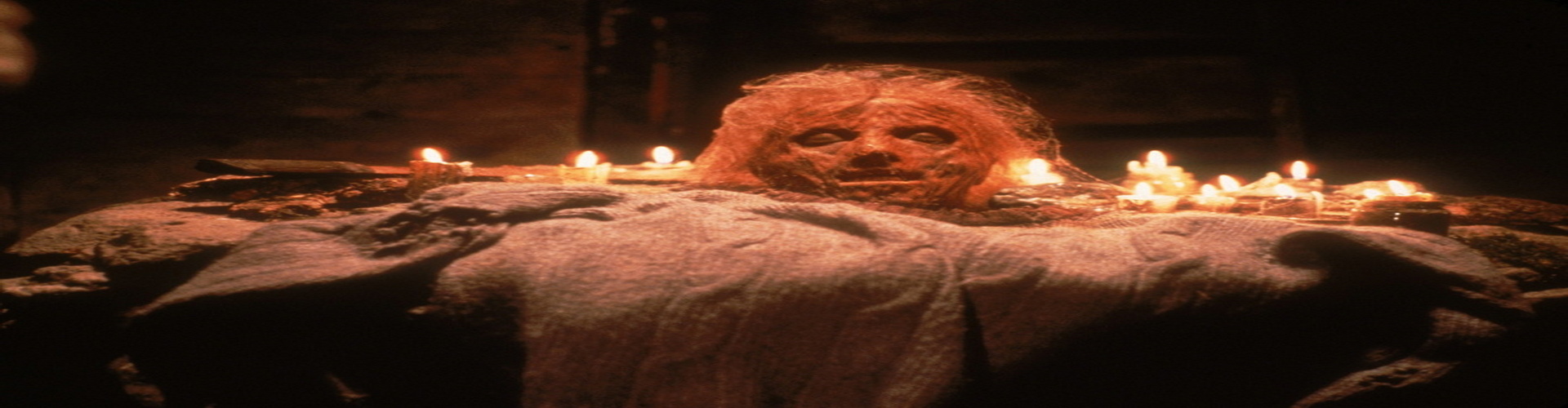
| We see "... a grotesque shrine centred around [Jason's] mother’s decomposing severed head." Credit: Paramount Pictures |
The cold open of Friday the 13th Part 2 does two things perfectly: it sets up the creepiest instalment in the series and establishes backstory that becomes central to franchise lore, as later recounted in the campfire sequence at the end of the first act.
Fading in on an establishing shot of a rain-drenched neighbourhood street at night, we see only one house with a light on in an upstairs bedroom, situated in the middle of the street's dead end, and we hear the eerie sound of a small boy singing "Itsy Bitsy Spider." When the boy’s mother calls him inside, the legs of a stranger walk toward the house, and it triggers returning composer Harry Manfredini’s iconic motif cue sting, which alerts us to the killer's presence - "ki ki ki, ma ma ma.”
Inside the house, we are reintroduced to sole survivor Alice Hardy (Adrienne King), who is having a nightmare in the illuminated bedroom. Director Steve Miner integrates a montage of clips into her nightmare to recap the climax of the first film detailing Alice’s brutal confrontation with, and eventual decapitation of, Mrs. Voorhees (Betsy Palmer, 1926 - 2015). Miner highlights specific moments to emphasize Mrs. Voorhees’ son, Jason. She explains her motivation to Alice for murdering her fellow camp counsellors: the negligence of the previous counsellors while having sex caused Jason to drown in 1957. We see imagery of his supposed drowning, alongside the legendary final jump-scare dream sequence where Jason rises from the lake and pulls Alice under. Instead of dumping a clunky recap at the beginning of the sequel before it continues this story, Miner smartly frames the summary as a character's nightmare, in a case of narrative efficiency that seamlessly continues it.
When Alice wakes up, the camera follows her as she does things around the house. We are given natural exposition when she answers a phone call from her mother, learning that Alice is spending time alone to cope with the trauma of that horrifying night. She then heads to the kitchen to look at her sketches, a character trait carried over from the previous movie. When the phone rings again, Alice answers, assuming it is her mother, but the caller hangs up - leaving both her and us uneasy. Hearing dustbins crashing to the ground outside the open kitchen window, she grabs the nearest sharp object - a screwdriver lying on the kitchen worktop - and approaches the window to investigate. Suddenly, a cat leaps through the frame and onto the kitchen table. This jump scare is incredibly effective, thanks to the dark atmosphere, tight pacing, and creeping dread built up beforehand. Like Alice, we breathe a sigh of relief.
Alice places the screwdriver on the nearby stove and sets the kettle to boil. However, when she opens the refrigerator door to get food for the cat, she is confronted by the ghastly sight of Mrs. Voorhees’ decomposing severed head and screams in terror. The stranger we saw creeps up behind her and drives the screwdriver into the side of her face. The camera goes to the cat meowing up at the intruder, who calmly removes the whistling kettle from the hob - a haunting, chilling image before the title card crashes onto the screen.
This prologue easily trumps the opening of the first film. It delivers a far more unsettling atmosphere, skilful suspense, and a palpable sense of anxiety, culminating in a much more impactful final blow that perfectly sets the sequel's grisly tone.
Much of Friday the 13th Part 2 focuses on establishing the mythos of Jason Voorhees. The tragedy of the original story, combined with the disappearance of its sole survivor two months later, who claimed to have seen him, forms the campfire legend that transforms Jason from a tragic backstory into the series’ main antagonist.
 |
| Alice (Adrienne King) finds a nasty surprise in her refrigerator. Credit: Paramount Pictures |
Five years later (placing the events in 1984), we are introduced to a new set of characters - or rather, slasher fodder for the machete-wielding maniac. A group of attractive teenagers arrives at a camp counsellor-training centre named Packanack Lodge. It is situated across the lake from the now-condemned Camp Crystal Lake, and crucially close to the hidden location of Jason’s makeshift, grotty little shack. While this predictable premise is a standard rinse-and-repeat affair, Friday the 13th Part 2 ultimately has a bit more depth to offer than its predecessor does.
Packanack Lodge is run by the young adult couple Paul Holt (John Furey) and Ginny Field (Amy Steel). Paul is a strong-willed leader with a dry sense of humour, while Ginny is arguably the best final girl of the entire franchise. Although she embodies the intelligent and resourceful archetype of this slasher trope, she possesses a unique edge that makes her stand out: her background in child psychology. Studying the subject at university, her understanding of a childlike mind gives her a distinct psychological advantage over Jason. As she sits at a local bar with Paul and the group jokester, Ted (Stuart Charno) - who holds the rare distinction of surviving by simply staying out late at bars - Ginny articulates a theory that the Jason legend might actually be true. He is a backwoods hermit, and a psychotic, deformed man-child, who witnessed the brutal murder of his mother, and is now crying out for her resurrection.
While there are significantly more teenage counsellors this time around, the narrative smartly focuses on a core group destined to become Jason’s victims. During a dinner scene, Paul announces one last night out on the town. As the majority of the group leaves for the bar, the camera pans across the counsellors as the remaining core group discuss their reasons for staying behind. Isolating these select characters creates far more room for taut suspense, and because these victims are more fleshed out, we have grown to know and like them.
Mark (Tom McBride, 1952 - 1995) is the most endearing of the group. Though he is wheelchair-bound, he maintains a remarkably positive outlook on life and a fierce determination to walk again. He forms the beginnings of a sweet romance with nice girl Vickie (Lauren-Marie Taylor), making their grim fates all the more tragic. Mark’s death stands out as one of the most mean-spirited kills in the entire Friday the 13th franchise due to its vicious lack of bias. Imagine a maniac driving a machete into the face of a beloved figure like the late Christopher Reeve - it evokes a visceral, sickening feeling - and that is exactly what this scene achieves. Vickie’s subsequent murder, in which we see Jason wearing his burlap sack mask for the first time, only amplifies the sadness, because we know the beautiful potential of what she and Mark were starting to build together.
 |
| Mark (Tom McBride) and Vickie (Lauren-Marie Taylor) could have had a beautiful thing together. Credit: Paramount Pictures |
The other highly memorable set piece is the gruesome double impalement of Jeff (Bill Randolph) and Sandra (Marta Kober) mid-coitus. The slasher sub-genre’s intrinsic link between sex and death is made explicitly clear here. This sequence is taken right out of Mario Bava’s 1971 giallo/slasher prototype, Reazione a Catena/Chain Reaction (A Bay of Blood, Twitch of the Death Nerve). Bava’s film heavily influenced the original film's secluded setting as well, and even Marcie’s axe-to-the-face murder mirrors the billhook execution of Bobby in the Italian picture. While its director Sean S. Cunningham and Part 2 director Steve Miner always maintained they had never seen Bava’s work prior to production, the influence came from behind the scenes. Philip Scuderi, an uncredited investor who wielded significant influence over the franchise during its Paramount years, was a massive fan of Reazione a Catena, and had even screened it throughout his Boston-based cinema chain, Esquire Theatres.
It was Philip Scuderi’s idea for the killer in Part 2 to be Jason Voorhees. Steve Miner - who had worked on the first movie as an associate producer, assistant director, and unit production manager - fully believed in the concept. Scuderi had previously hired screenwriter Ron Kurz (1940 - 2020) to do uncredited rewrites on the original, and brought him back to pen the sequel. Kurz completely transformed how the previous film’s ending was perceived by radically retconning the franchise's mythology.
In this new context, Jason rising from the lake remains Alice’s dream sequence, but it now serves as an ominous foreshadowing of her murder in vengeance for Alice killing his mother in self-defence. Kurz never bothers to explain how Jason survived his childhood drowning, or why he never tried to contact his mother. However, a feasible theory is that after surviving, and as he was never found, Jason chose to withdraw from the world to live a lonely existence as a backwoods hermit. Knowing he could never function normally in a society that viewed him as a freak outsider, he isolated himself. Mocked, shunned, and ignored by other children - and neglected by the copulating camp counsellors who nearly caused his death - he likely did not want to be a burden to his mother. Ironically, her belief that her son was dead carried catastrophic repercussions, as her grief fuelled the severe psychosis that led her to murder nine innocent people. Having witnessed her death, Jason internalized her trauma and carried on her bloody work for his own vengeance - punishing the world that had wronged them both. He inherited her fatal compulsion that sex equals death, murdering the horny teenagers entering his woods in a vicious cycle where violence begets violence.
Paul’s campfire tale to spook his trainees wonderfully pieces all of this backstory together. Yet, Paul dismisses the legend as a mere campfire myth. It is all part of a planned prank: just as he finishes his story, a man with a spear leaps out and terrifies the group, only to reveal to be Ted wearing a mask. Paul reassures the teenagers that Jason is dead and strictly declares Camp Crystal Lake off-limits. By mocking and ignoring the genuine horror of the Jason legend, Paul and Ted unknowingly portend the teenagers’ tragic fates.
 |
| Paul’s campfire tale about the terrifying legend of Jason Voorhees spooks his trainee councellors. Credit: Paramount Pictures |
Jason’s choice of attire in Part 2 - wearing a simple burlap sack with a single eyehole - feels incredibly lazy and severely lacking in originality. It stands as a blatant aesthetic rip-off of the Phantom Killer’s iconic look in the 1976 proto-slasher, The Town That Dreaded Sundown. Thankfully, we all know this would not last.
During the intense, climatic confrontation between Ginny and Jason, the true significance of her background in child psychology becomes clear. Trapped inside Jason’s squalid shack, Ginny discovers a grotesque shrine centred around his mother’s decomposing severed head. As Jason furiously hacks through the door with a pickaxe, Ginny deduces his identity and psychological tether to the relic. In a desperate, brilliant move, she slips into the filthy jumper Mrs. Voorhees wore when she died, and conceals a machete behind her back. When Jason finally breaks through, Ginny manipulates his fractured psyche by posing as his deceased mother. We see the spectral imagery of Mrs. Voorhees speaking through Ginny, highlighting her tactical advantage, and splendidly illustrates Jason's regression into a vulnerable, childlike state.
The final jump scare mirrors the execution of the first film's ending, utilizing a calming, melodic score to lull us into a false sense of security. The peace is abruptly shattered when Jason - his deformed visage fully exposed, and the machete still embedded in his shoulder from Ginny’s earlier strike - crashes through a cabin window to grab her.
When the film cuts back to the shack for its final shot, the camera slowly zooms in on Mrs. Voorhees’ decomposing head, holding on a grim freeze-frame for a last lingering look at the matriarch, all while accompanied by Harry Manfredini’s uncanny music. It remains one of the most tremendously macabre final images in slasher horror history.
 |
| With her background in child psychology, Ginny (Amy Steel) ".... manipulates [Jason's] fractured psyche by posing as his deceased mother." Credit: Paramount Pictures |
The original Friday the 13th was always intended as a one-and-done cash-in on Halloween (1978) - John Carpenter’s masterclass template for the slasher sub-genre. Part 2 is where the franchise truly begins, as most of its definitive chess pieces are being put into play. There is even the first full-frontal female nudity (courtesy of Kirsten Baker as Terry). It stands as a vastly superior film to its predecessor: better written, better directed, and better acted. The pacing is much livelier, the characterizations of these sympathetic young people have far more meat on their bones, and they are portrayed by a bright, energetic cast. Amy Steel’s Ginny Field ranks among the very best final girls in slasher horror. Friday the 13th Part 2 is a quintessential series entry and one of the better examples of the slasher film during its 1981 peak year of saturation - the pinnacle of the first cycle. From here, the formula merely required a minor tweak: a more physically intimidating, hulking brute of a Jason Voorhees wearing a far better, more iconic mask.
Note: In the wake of the original film's success, the MPA (then the MPAA) began cracking down heavily on slasher horror due to an avalanche of complaints regarding uncensored violence. Consequently, subsequent sequels and standalone slashers were severely neutered, noticeably diminishing their visceral power. Much of SFX make-up artist Carl Fullerton’s work on Friday the 13th Part 2 ended up on the cutting room floor. Fortunately, this fabled, long-lost footage was eventually recovered from his personal VHS tape, and was fully preserved as a bonus feature on the Scream Factory Deluxe Blu-ray Box Set.
© 2026 Dave J. Wilson. All rights reserved.


