
 |
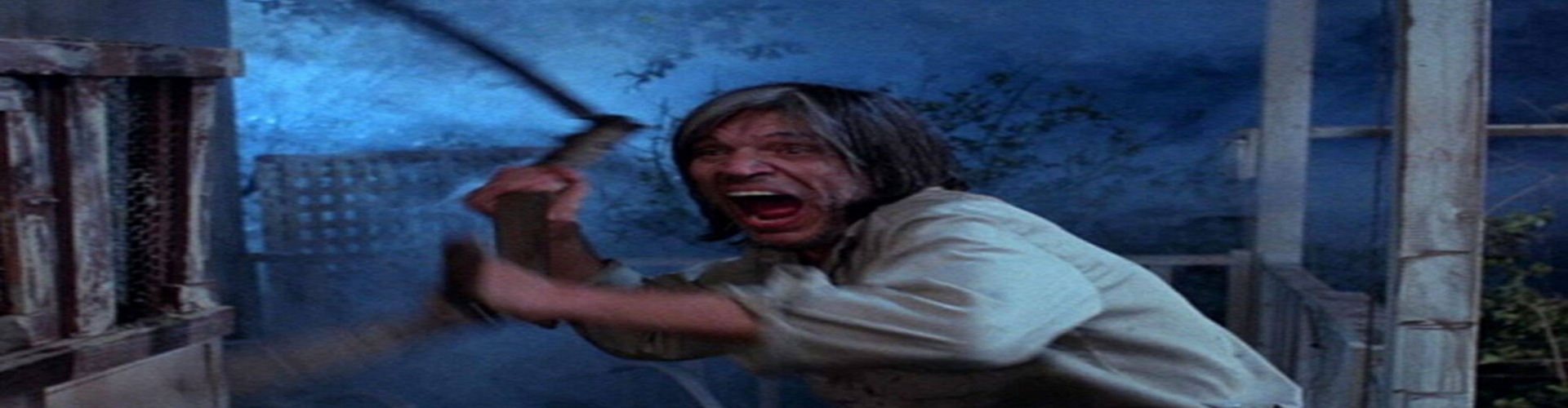
| Judd (Neville Brand) is 'sickle' of your shit. Credit: the Rustam estate |
Tobe Hooper (1943–2017) followed up his 1974 debut masterpiece, The Texas Chain Saw Massacre, with Eaten Alive (Death Trap, 1976). While his debut was a groundbreaking critical and commercial success that left a massive cultural footprint, this odd little proto-slasher was never going to appeal to a mainstream audience. It is an exercise in atmospheric surrealism where narrative takes a backseat. Anyone expecting more of the same in 1976 was severely disappointed, a fact reflected in the film’s disastrous theatrical run. Yet over the last half-century, it has gained a dedicated cult following, and this experimental curio is certainly worthy of re-evaluation.
Eaten Alive continues Tobe Hooper’s fascination with America's paranoia regarding the Deep South and its inhabitants. While The Texas Chain Saw Massacre was inspired by Plainfield, Wisconsin, serial killer Ed Gein, Eaten Alive draws from 1930s Texas bar owner Joe Ball. Known as “The Alligator Man”, Ball allegedly murdered several women and disposed of their bodies by feeding them to the live alligators he kept at his bar as an attraction. In a slight shift, the film's antagonist keeps a pet Nile crocodile. Unlike The Texas Chain Saw Massacre, where Hooper ingeniously made us think we were seeing more gore than what was actually on screen, here he goes all out with graphic depictions of sadistic slaying and crocodile-munching carnage.
Screenwriters Kim Henkel (The Texas Chain Saw Massacre), Alvin L. Fast, and Mardi Rustam (1932–2023, who also produced) utilize a narrative structure closely mirroring Alfred Hitchcock’s Psycho (1960).
 |
| This croc has a big appetite. Credit: the Rustam estate |
Young runaway Clara (Roberta Collins, 1944–2008) has been working and living in a local brothel in the remote swampland of rural Texas for a few weeks, when she is thrown out for refusing to comply with the anal sex demands of a scumbag local redneck, Buck (Robert Englund). The luckless young woman makes her way to the dilapidated Starlight Hotel, where she has the misfortune of meeting its owner—the disturbed war veteran Judd (Neville Brand, 1920–1992). Judd walks on a wooden leg and is the proud keeper of a gigantic Nile crocodile confined to a pen right next to the hotel. When he realizes Clara is a prostitute from the nearby brothel, this triggers his rage. After a brief tussle, he attacks her with a pitchfork, stabbing her to death, and throws her body into the apex predator's pen for its next meal.
Shortly after, a vacationing family turns up on their way through town. When their dog wanders off to the pen and is promptly eaten, their little girl, Angie (Kyle Richards), becomes hysterical. The parents decide to rent a room for the night to calm Angie down and recover from the trauma. After an argument between father Roy (William Finley, 1940–2012) and mother Faye (Marilyn Burns, 1949–2014), Roy decides to take the protective fatherly route and shoot the giant croc with his rifle. Judd takes exception to this, murders Roy, and feeds him to his beast. He then beats Faye and chases Angie underneath the hotel foundations right next to the crocodile pen, trapping her there for the rest of the film while her mother remains gagged and tied to a bed upstairs.
This proves to be an all-around bad night for the unhinged Judd, as a father and daughter soon show up at the hotel searching for the missing Clara—their daughter and sister, respectively. Judd slyly suggests they check out the local brothel. Accompanied by Sheriff Martin (Stuart Whitman, 1928–2020), they visit the establishment, but the madame, Miss Hattie (Carolyn Jones, 1930–1983), claims she has never seen Clara. Upon returning to the hotel, the father is brutally attacked by Judd with a sickle and becomes the reptile's third human meal, while his daughter remains back in town with the sheriff. The sleazy Buck then turns up with a new girlfriend to cause even more trouble for Judd, as the hotelier continues trying to flush Angie out from beneath the building, while Faye remains bound and gagged upstairs.
 |
| Angie (Kyle Richards) doesn't want to become crocodile food like her poor little doggie. Credit: the Rustam estate |
These narrative threads string together the film’s main strengths—its grisly imagery, sleazy edge, and a downright weird atmosphere. Outside of this loose plot, however, the pacing severely drags. The characters often sit around engaging in aimless dialogue that does nothing to advance the story. This ponderous, stagnant, middle section stands as the film's main weakness, threatening to bore us to tears.
While similar in context and thematic tone to The Texas Chain Saw Massacre, Eaten Alive is a completely different visual experience. Tobe Hooper shot his legendary debut entirely on location, capturing the gritty naturalism of the dusty wide-open spaces and the baking landscapes of rural Texas. Here, everything is confined to Hollywood sound stages, and the set designs are noticeably cheap, tacky, and fake. Yet, the artificial nature of these shoddy sets—combined with cinematographer Robert Caramico’s hyper-stylized, garish, and intense red and green lighting techniques in a perpetual night setting—amplifies the strangeness of the detached narrative to create a dreamlike, twilight world. This surrealistic, nightmarish journey through claustrophobic, suffocating madness and sweating panic in the heat of the Deep South effectively borders on arthouse horror.
The film's other major asset is its all-star supporting cast of genre veterans:
• Robert Englund: Quentin Tarantino famously borrowed the name of Englund’s character, Buck, and paraphrased his opening line for Kill Bill: Vol. 1 (2003), shifting it from “Name’s Buck… and I’m rarin’ to fuck” to “My name is Buck… and I’m here to fuck.”
• Roberta Collins: A 1970s exploitation regular known for Women in Cages (1971), Caged Heat (1974), and Death Race 2000 (1975).
• William Finley: A quirky and versatile character actor best known for his collaborations with Brian De Palma in Sisters (1972) and Phantom of the Paradise (1974). He would later reteam with Tobe Hooper for The Funhouse (1981).
• Marilyn Burns: Famous for originating the "final girl" slasher trope in The Texas Chain Saw Massacre.
• Kyle Richards: A child actress who would go on to play her most famous horror role as little Lindsey Wallace in John Carpenter’s Halloween (1978).
• Carolyn Jones: Jones is iconic as the original Morticia Addams in the TV show The Addams Family (1964–1966).
Tobe Hooper would subsequently fare much better with his acclaimed Stephen King TV miniseries adaptation, Salem’s Lot (1979), the aforementioned The Funhouse, and his massive supernatural smash hit, Poltergeist (1982). Nevertheless, Eaten Alive retains a distinct power through its fever-dream atmosphere, gruesomeness, sleaziness, and an exceptional ensemble of cult actors—making this well worth seeking out for horror enthusiasts, despite its more pedestrian scenes.
© 2026 Dave J. Wilson. All rights reserved.


