
 |
| After avenging the tragedy of his friend, John Eastland becomes the exterminator of society's ills. Credit: StudioCanal |
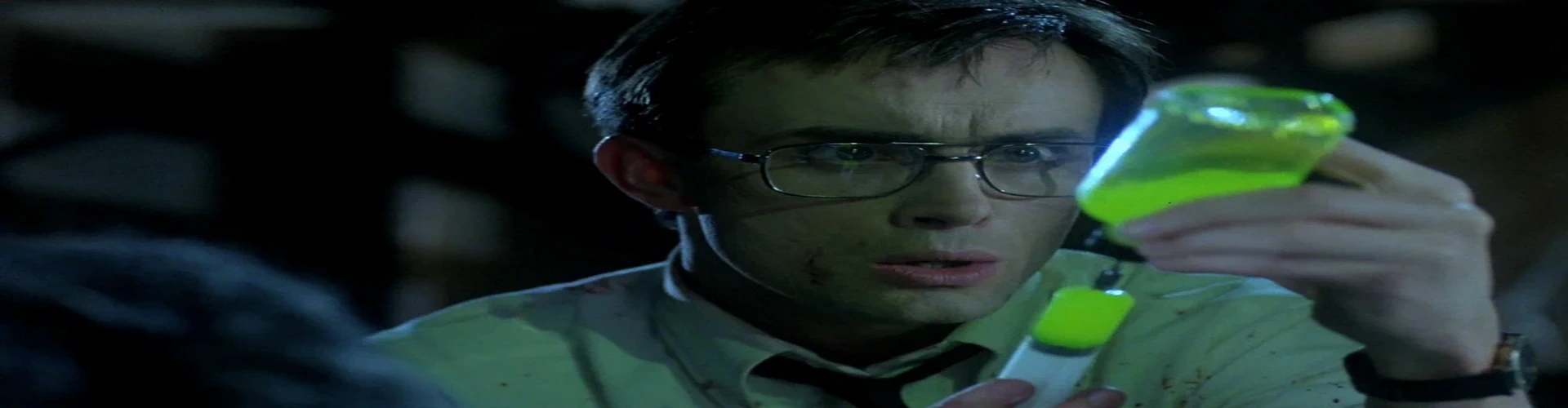
The tagline on the theatrical poster of The Exterminator reads, “In war, you have to kill to stay alive… on the streets of New York, it’s often the same.” There is a moment in the film when protagonist John Eastland (Robert Ginty, 1948 - 2009) tells his best friend and brother-in-arms, Michael Jefferson (Steve James, 1952 - 1993), “I found the guys that did this to you, and I’ve taken care of it. It’s strange; it feels like we were back in Nam. It didn’t matter whether it was right or wrong, I just did it.” Michael is lying on a hospital bed and is on life support, as John tells him this. Michael is a husband and father of two, who saved John‘s life in the Vietnam War. Michael was the victim of a vicious attack by a street gang named the Ghetto Ghouls, in which they gouged his spine with a meat hook, leaving him paralysed for life. John retaliated with swift and brutal retribution.
Much like Michael Winner’s Death Wish six years before it, James Glickenhaus’ The Exterminator was born from the frustrations of citizens inhabiting densely populated cities. This was due to the high crime rates, and the police and politicians’ inability to deal with it and protect them. Filmed at the tail end of 1979, it unflinchingly depicts the urban decay of New York of the era. It is a nasty piece of exploitation - a gritty, grim, grimy, sleazy, and über violent vigilante actioner. It is set in two locations of the city: 42nd Street, Times Square, which ironically, is populated by the grindhouse theatres that showed exploitation pictures such as this, and in the cesspool of Hell’s Kitchen. Its lack of visual flair only works to its advantage in painting a bleak portrait of the mean streets that are mostly shot at night.
However, the film is thoughtful with its sympathetic portrayal of Vietnam veterans’ inner turmoil, as they try to cope with their returns to society and fit in, just four years after the end of the conflict. John’s PTSD deepens the narrative, as his traumatic experiences have left him with deep-seated scars, and we empathize with him. He is a quiet loner, has no other friends, has no family, other than Michael and his wife and children, and he is fiercely loyal to them. After John takes revenge for his friend, he gets the hunger for vigilante justice, and turns New York City into his personal warzone. He now has another use for his military training that gives him purpose. He has found his place by being judge, jury, and executioner of the dregs of the society he has been forced back to. He has been a delayed bomb, and it took him being pushed too far to go off. We root for him to take out the scumbags, as he remains compassionate to their victims. What Robert Ginty lacks in charisma and versatility as an actor works within this context, as his character is an everyman like you and me. This is what makes him identifiable as an anti-hero. John sends a letter to the media signed with a nom de guerre (war name) as ‘The Exterminator’.
 |
| John deals out brutal punishment on a scum child sex ring. Credit: StudioCanal |
One of the most compelling parts of The Exterminator is inspired by Martin Scorsese's Taxi Driver (1976):
A
man picks up a 20-year-old female hooker. He turns out to be a child sex
ringleader, when he takes her to his “chicken place”, which is a
street slang term for a prostitution house where young children are provided to
paedophile clients. Here an elderly state senator wants to have a threesome
with her and a boy. She is disgusted by this, so refuses and tries to leave,
but they take her to a bed, tie her to it, strip her, and the old vile pervert
scalds her breasts with a soldering iron.
Later,
by chance, she approaches John on the street as a potential customer, and he
accepts her proposal, so they go to a seedy room. When she undoes her blouse,
he sees her unsightly scars, and she tells him what happened. He promises her
nobody will hurt her again. He tracks down the child sex trafficker and his
client that did this to her. He gets into the place by posing as a sex trader
who wants to sell a boy. When he gets the response he needs for confirmation,
it makes him angrier and his punishment of these sick fiends more severe, as he
dispatches them with such malice.
The
set-up seeks our revulsion, and then we are given catharsis, as we see this
slime of humanity get their comeuppance in exploitative thrills. Then we are
emotionally rewarded with John’s endearing act of human kindness, when he
unties a young boy who the senator was abusing, and comforts him. These scenes
were shot in an illegal prostitution house on 42nd Street, which had just been
closed down by the police.
 |
| Christopher George gives one of the most solid performances as Detective James Dalton, and provides moments of levity in a grim affair. Credit: StudioCanal |
Juxtaposed to these horrid events are romantic scenes
between Detective James Dalton (Christopher George, 1931 - 1983) and Dr. Megan
Stewart (Samantha Eggar, 1939 - 2025). Dalton is investigating John’s murders,
and is himself a Vietnam War veteran. Meagan is overseeing the treatment of one
of John’s low-life victims. While they are having a late-night picnic in
Central Park, the other events take place simultaneously. As we hear the sound
of non-diegetic sentimental music, the camera leaves them with an aerial shot
to establish the bright lights of the city. It then cuts to the setting of 42nd
Street, where we see the child sex ringleader pick up the young prostitute.
When the heinous act has been committed, the film goes back to Dalton and
Samantha’s date. This is a contrast between light and dark. We see a fledgling
romance, but we are reminded that it is a harsh and cruel world by the
prostitute’s horrific ordeal.
This is further emphasized during their second date.
Samantha asks Dalton what it was like in Vietnam, to which he replies it was
bad, but not as bad as New York. It then cuts to an old woman being mugged by
the remnants of the Ghetto Ghouls. John had interrogated one of them before to
find Michael’s attackers, but this time, he does not let him off. This
perfectly illustrates the tagline, “In
war, you have to kill to stay alive… on the streets of New York, it’s often the
same.”
There are some much-needed moments of levity from
George’s Dalton. He says to an interfering CIA agent, “I think you have to
take a shit, it’s coming out of your mouth instead of your asshole.” Christopher
George gives one of the most solid performances.
The CIA does not want the NYPD to bring in John
because they would rather assassinate him. The presidential election is coming
up, and they do not want to risk the trial bringing up some "embarrassing issues",
because the president’s campaign promises include fixing his administration’s
inability to tackle crime. They suspect John’s vigilante work is a conspiracy
by an opposition party or a foreign government. John’s way of clearing up crime
gets more results than the government could hope for, but it exists outside of
its judicial system. They would rather take John out of the picture than let
him shame its inadequacies by his more violent yet effective methods. It is not
as simple as good vs. evil on the streets of New York, as nothing is black and
white. Just like in Nam, it is always politics.
 |
| The UK pre-cert VHS release of The Exterminator. |
The Exterminator was a hit at the US box office,
grossing $5 million on a small $2 million budget, and would find more success
on the home video market. I can remember it being a favourite rental of adults
in the UK. When I was growing up in South East London, England, in the 1980s, I
would go with my parents to our local video rental store called Showtime Video.
One of my earliest memories of this is seeing the big box VHS cases of The
Exterminator and its 1984 sequel, Exterminator 2. The
latter of which was produced by Cannon Films, and was less successful, both
artistically and commercially. The infamous image on both the theatrical poster
and the video case cover of The Exterminator, features a man
wearing a motorcycle helmet, and wielding a flamethrower, but this does not
feature in the film. Whereas the artwork for Exterminator 2
features a man wearing a welding mask, and is using a flamethrower too, which a
returning Robert Ginty does do.
The film descended into obscurity in the 1990s, but
due to the rapid rise of DVD and the internet at the turn of the century, it
developed a cult following thanks to film fans and commentators spreading
awareness of it. At the time of writing, Arrow Video’s 2011 Blu-ray release is
the best way to watch it at home.
The Exterminator delivers on its promise with
satisfying brutality on the scum that deserves it. Although the pathos in its
examination of post-Vietnam War anxieties, sets it apart from the slew of urban
vigilante action movies of the time that were inspired by Death Wish.
© 2026 Dave J. Wilson. All rights reserved.


