September 12, 2026

REVIVING LOVECRAFT IN THE PRESENT: 'RE-ANIMATOR' (1985)

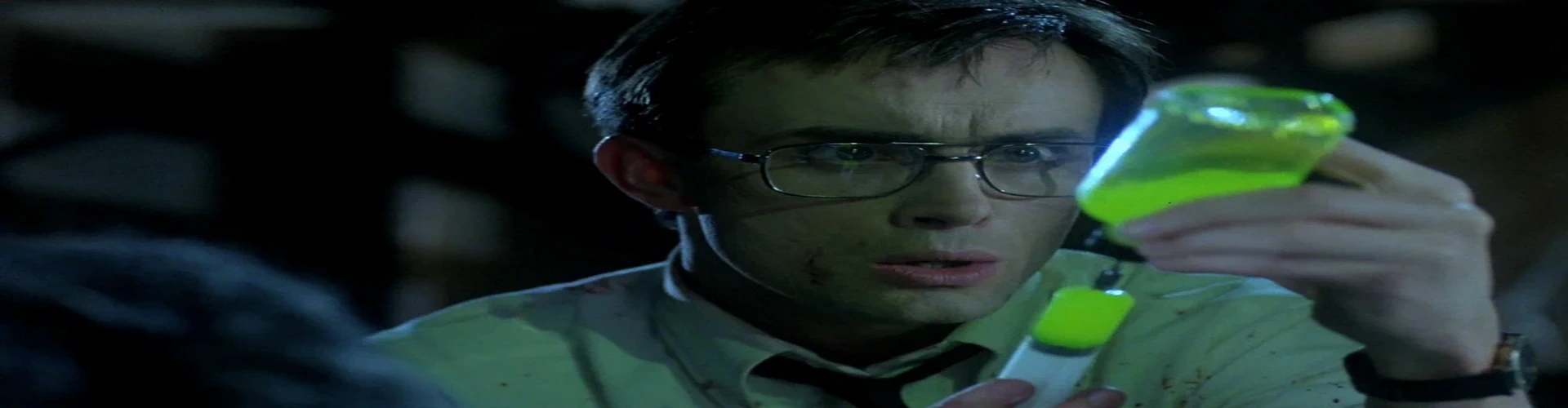
 Herbert West (Jeffery Combs) is about to inject his reagent into human flesh to re-animate the dead. Credit: Re-Animator Productions

Re-Animator is a loose contemporary adaptation of H. P. Lovecraft’s serialized short horror story, Herbert West–Reanimator (1922). It is a satire on Mary Shelley’s most acclaimed and famous work, her Gothic novel, Frankenstein; or, The Modern Prometheus (1818), but it is done so respectively as a loving homage. Herbert West–Reanimator is the first piece of literature to depict uncontrollable and animalistic reanimated corpses. The film takes its inspiration from all of the episodes in Lovecraft’s serial.

Re-Animator is the feature directorial debut by Stuart Gordon (1947 - 2020) - one of the great unsung genre filmmakers. It is his first of five collaborations with screenwriter Dennis Paoli based on H.P. Lovecraft’s work: From Beyond (1986), The Pit and the Pendulum (1991), Castle Freak (1995), and Dagon (2001). For Re-Animator, Gordon (who co-wrote the screenplay) and Paoli, get to grips with the source material’s intended ridiculousness. Its unconventional narrative and perfect balance of imaginative, over-the-top, gory, body/zombie horror, and dark humour, makes for a bizarre and macabre experience. But it is hard to imagine that this would have worked half as well if it did not have such a talented ensemble cast.

Herbert West (Jeffrey Combs) is a medical student who has just enrolled at the fictional Miskatonic University, situated in the fictitious city, Arkham, Massachusetts, Northeastern United States. He has just returned from Zurich, Switzerland, where he was studying under the renowned professor, Dr. Hans Gruber. Gruber died under mysterious circumstances while he and West were researching regeneration. West clashes with Dr. Carl Hill (David Gale, 1936 - 1991), when he accuses him of plagiarizing Gruber’s work, and ridicules his theory of the brainstem’s length of survival after death. 

West soon involves his new roommate, and dedicated trainee surgeon, Dan Cain (Bruce Abbott), in his continued regenerative experiments, when West turns the house’s basement into his personal laboratory. He reanimates the dead by injecting a glowing green serum he has created into their tissue. Dan becomes fascinated with this after witnessing the results with his fiancée’s dead cat. 

Dan’s fiancée is Megan Halsey (Barbara Crampton), who becomes unintentionally involved, forming an odd triangle. She is the daughter of the dean of the university, Alan Halsey (Robert Sampson, 1933 - 2020). The middle-aged Dr. Hill is obsessed with the young and beautiful co-ed.

When Dan smuggles West into the hospital morgue, this is where the horror really begins, as the reanimated cadavers turn into out of control and violent zombies.

"... the reanimated cadavers turn into out of control and violent zombies." Credit: Re-Animator Productions

The cast plays it straight. Their characters take the strange and frightful situations they find themselves in seriously, and the off-the-wall comedic relief organically comes from the absurdity of these predicaments. The humour feels authentic and real. Re-Animator deftly mixes horror and black comedy, and is one of the best examples of doing so.

The brilliant and eccentric scientist, Herbert West, is an arrogant narcissist, and a creep. But due to Jeffrey Combs’ quirky charm and immense charisma, and aided by the pitch-black comedic elements, he makes for an anti-hero who is impossible not to like. West’s characterization does not fit into the evil villain category, because he has no moral alignment, as he is just fiercely driven and obsessed with achieving his goals.

West’s partner in crime, Dan, is hugely likable as an all-round good guy with a caring nature, but is naive. He has everything: young, handsome, bright, respected, attending medical school on a scholarship, and is in love with the dean’s beautiful daughter. The world is at his feet. We identify with him because he is a normal person just trying to make his way in the world, and things are looking up for him. This is until he meets West, and is thrust into the madness that destroys everything he has worked so hard to achieve. We relate to this on an emotional level, because we know that life can take everything away from us just like that. Dan is the surrogate for the audience. In the first post-title scene, Dan tries his damnedest to resuscitate a patient, but fails. Doctors strive to beat death, and this is why West’s reanimation agent captivates Dan. The film’s ending goes back around to its beginning.

Megan challenges West at every turn, because she sees his work as wrong, and thinks he is leading Dan down a dark path away from her. West finds her to be an inconvenience, getting in the way of him and Dan. They fight over Dan’s soul: Megan wants them to have a life together, but West needs his help. Dan loves Megan, but the surgeon in him fighting to save lives believes in what West is doing. Dan and Megan have a wonderful romance, but it is tragically cut short. Director Stuart Gordon focuses on the dramatic tension in this intense conflict with heart and passion for the material. This is real human drama, which goes beyond the film’s shock value, and is another reason for its enduring legacy as a cult horror classic.

Megan Halsey (Barbara Crampton), Herbert West (Jeffrey Combs), and Dan Cain (Bruce Abbott) form one of the greatest ensembles in horror cinema. Credit: Re-Animator Productions

Barbara Crampton gives a brave and bold performance as Megan. She had no qualms giving us the full-frontal nude goods in a disturbing prolonged sequence during the gruesome Grand Guignol finale, when the real villain of this horror piece sexually assaults her.

The evil Dr. Carl Hill is hungry for wealth, fame, and power. He is a fraud, who as well as pilfering Dr. Gruber’s ideas, wants to steal Herbert West’s research too. He is a despicable human being who fittingly ends up as the ghastly creature he becomes.

Composer Richard Band’s music score is a blatant rip-off of Bernard Herrmann’s iconic composition for Alfred Hitchcock’s Psycho (1960). But its franticness perfectly complements the film’s energetic pace and zaniness of its events.

The 86-minute unrated version was released in North American theatres for the Halloween season in October 1985. This was to avoid an X rating - the box-office kiss of death. It was made available on VHS, Betamax, and LaserDisc there, and on videotape in my native United Kingdom, where it received an 18 certificate. The home video market is where Re-Animator found most of its audience. I first saw it when I rented it from my local Blockbuster Video in South East London, England, during the mid-‘90s. This version is perfectly paced and has all of the graphic gore and nudity intact. I loved it.

 Megan receives unwanted head. Credit: Re-Animator Productions

When I read in a TV guide that the BBC was showing Re-Animator late one night, I stayed up to watch and recorded it. I was shocked to see that most of the ingenious gore effects created by SFX artist John Carl Buechler (1952 - 2019) and his team, and much of Barbara Crampton’s nudity, were edited out. This is the inferior R-rated cut. Because media outlets refused to advertise unrated films, it was re-edited and submitted to the MPAA during the first quarter of 1986, and was given an R rating. It replaces the gory set pieces with 16 plot scenes that help us to understand the more confusing parts.

This cut features Dr. Hill having the power of hypnosis to make people do what he wants. We see why Megan’s father suddenly turns on Dan, who he was fond of before. However, it can be interpreted in the unrated version, when Dan tells him about his findings with West’s experiments, that he loses his temper with Dan because it infuriates him as a man of science, and dismisses his claims as nonsense. This sub-plot makes for overstuffed proceedings, because the focus of West reanimating the dead is enough to sell the movie.  

In the R-rated cut, Megan shows much more suspicion of Herbert West. And he is made unlikable because he is portrayed as a woman hater, showing such disdain towards Megan because she is female, whereas in the unrated version, it comes off that he is just irritated by her interference. It was a wise decision to leave West’s misogynistic character traits on the cutting room floor, because it is hard to make an anti-hero work with such foul views on women.

Dan discovers West injecting himself with a watered down concoction of his own fluid, because he uses it to battle fatigue, and is addicted to it.

These two characteristics of Herbert West were not passed over to Re-Animator producer Brian Yuzna’s sequels as director: the worthy Bride of Re-Animator (1989), and the not so worthy Beyond Re-Animator (2003). This is testament to the original’s unrated version as being the definitive vision of the film. 

While it is interesting to see this extra footage, the unrated version works much better, because it is livelier and more outrageously gory fun. The R-rated cut zaps the energy out of the brisk pace as it is a drawn out affair, its added plot points makes for a more downbeat mood, and there is not much in the way of gore. It makes for a far less good time. 

The Integral Cut had its world premiere in 2013 when it was released on Blu-ray in Germany. It includes everything and runs at just under 105 minutes. Oddly enough, though, it slightly trims Barbara Crampton’s nudity, as alternative shots from the R-rated cut are used for an early scene. 

I highly recommend that newcomers to Re-Animator see it unrated first, and then watch the Integral Cut as an alternative curiosity, but avoid the butchered R-rated cut at all costs.

This is essential viewing. The heartfelt and emotional drama, black as coal humour, excellent dialogue, all delivered pitch perfectly by the fantastic cast, tremendously grotesque special effects, and shocking and disturbing moments - are the reasons why this important genre work has gained its legendary cult status. Re-Animator is one of the best horror films of the 1980s.

© 2026 Dave J. Wilson. All rights reserved.


Credit: Re-Animator Productions

Read More →

September 10, 2026

FROM THE DRILLER KILLER TO ‘KING OF NEW YORK’: ABEL FERRARA’S 1990 DREAMLIKE NEO-NOIR CRIME OPUS

Christopher Walken as Frank White in King of New York. Credit: New Line Cinema

I discovered Abel Ferrara’s King of New York when I saw the advertisement for its release in the United Kingdom on 21st June 1991, in the British tabloid newspaper, The Sun. I was fascinated by the artwork used from the theatrical poster that depicts a large stylised central image of its star, Christopher Walken. He is wearing a suit, his arms are crossed, he is weirdly holding a handgun by its trigger with his left forefinger as the gun’s barrel faces down, and he is standing against the backdrop of the New York City skyline at night. The classic and minimalist aesthetic presents this neo-noir crime joint’s genre and its dark and gritty tone. The feature itself is also a mood piece with a dreamlike quality.

There was no buzz about King of New York, as film critics dismissed it as style over substance, and it came and went in the cinemas. I can remember seeing the TV spot, and I used to repeatedly watch the trailer on the videotapes that I rented from my local Blockbuster Video. I was transfixed by its dark, moody and dangerous atmosphere, induced by its extraordinary visuals and its New York setting, and the clips of its Hong Kong-esque shoot-out set pieces.

The last moment of the trailer always grabbed me. In a close-up shot of Christopher Walken, he says part of a line taken from his great monologue in a pivotal scene in the film’s climax. His character, a drug lord named Frank White, confronts NYPD lieutenant, Roy Bishop (Victor Argo), who has been trying to take him down, one night in Bishop’s apartment. White explains his motivation for taking out his rivals in the criminal underworld, when he realizes that his dream of doing great things for the city and its people was just that: he was delusional. The iconic actor is chilling in his delivery as his character rationalizes his actions, “… I never killed anybody that… didn’t deserve it.”

At the time I discovered King of New York, I was not familiar with the work of Abel Ferrara, but I took note of his name as the director. As a budding young horror aficionado, I was aware of the controversial reputation of his ‘legit’ first directorial feature, The Driller Killer (1979), as a video nasty, although I did not know, it was his film. Ferrara is also the lead actor in it. It made it on the Director of Public Prosecutions’ (DPP) Final 39 list of prosecutable titles, and it was banned under the Obscene Publications Act 1984.

I had seen the infamous graphic image on the cover of Vipco’s VHS release, which is what got The Driller Killer in trouble, on TV news segments and documentaries about the video nasties scandal. It depicts a man being drilled through his forehead, which is taken from a scene in the film. By the time the ban was lifted in 1999, I knew Abel Ferrera was the director, and I had seen ten of his pictures, including King of New York. However, this was an edited version to remove the explicit violence. Due to being a big fan of the filmmaker’s work, and my strong aversion to the censorship of art, I did not want to see his vision compromised. I was finally able to watch The Driller Killer in its true uncut form, when it was approved by the BBFC and released on DVD in the UK in 2002.

Abel Ferrara made his directorial feature debut with the hardcore pornographic film, 9 Lives of a Wet Pussy (1976). This was under the pseudonym, Jimmy Boy L. It marked his first collaboration with screenwriter Nicholas St. John, under the pseudonym, Nicholas George. They met at high school and graduated from university at the same time. They would subsequently work together on The Driller Killer, and then on eight more projects, including King of New York. The last was The Funeral (1996), which also stars Christopher Walken. This signalled the end of an era in Ferrara’s career, as the rest of his work that followed is avant-garde with non-linear narratives, and is very niche.

"The classic and minimalist aesthetic presents this neo-noir crime joint’s genre and its dark and gritty tone." Credit: New Line Cinema

All of Abel Ferrara’s work has been personal since The Driller Killer. He only makes films that interest him about what surrounds him in his world as a New York-centric filmmaker. King of New York is the same. Both pieces are sociological reflections on different times in his life in two distinct periods of New York City, and are made in two distinctive filmmaking styles.

The aesthetic of the The Driller Killer is that of a raw docu-drama. Through improvisation, it captures the lifestyle of the director and his filmmaking crew, living from day to day on limited resources. It was shot in their neighbourhood in Union Square (including in their apartments) and at their local hangouts without permits between 1977 and 1978. This micro-budget guerrilla filmmaking is a byproduct of their financial reality. It is set around the culture of the punk rock scene, and we can feel its aggressive energy.

The Driller Killer is a character study about a financially strapped, stressed-out, and struggling young artist and his frustrations with society. Therefore, it is fitting that the independent filmmaker, Ferrara, played the role. His character suffers a mental decline, and violently murders the homeless with a power drill, due to his daddy issues, as his estranged father is a derelict, and he kills the people that he feels have wronged him.

Abel Ferrara makes us see the life of the grim, grimy and sleazy urban decay of the pre-sanitized New York, and makes us feel its grittily intense atmosphere. He always treats the city like a character itself, as if it is a living antagonist to his always-flawed protagonists, who strain under the immense pressure of its harsh and cruel surroundings, which have inflicted upon them their miserable existences. Ferrara thrives on chaos, as the self-destructive themes of his films reflected his own life at this time, as they are fuelled by his substance abuse and alcoholism.

Fasting forward just over a decade: Abel Ferrara has made a successful career directing low-budget exploitation pictures. The best of these are Ms. 45 (1981) and China Girl (1987). In King of New York, the 1980s are drawing to a close. The New York scene’s gangsters have become rich dealing crack cocaine just like Frank White. And Ferrara and his close filmmaking community were now living an exuberant lifestyle of drugs due to the director’s growing artistic success.

King of New York is closer to being a Hollywood production more than anything else that Abel Ferrara has created. He travels to the border of the mainstream, but this is where he stops. He dips his toes in these waters, almost as if he is daring himself to prove he can make a film that is more accessible for general audiences. While still shot entirely on location, the scenes are meticulously staged, and are beautifully lit, like a major studio production. Bojan Bazelli’s exquisite cinematography is a clear distinction of Frank White’s high living and vicious street dealings, with warm orange/cold blue lighting. This is a significant departure from Ferrara’s previous underground, free-form filmmaking, and he does it successfully, with a seemingly effortless alteration.

Ferrara does not forget his exploitation roots, however. It hits that sweet spot between exploitation and arthouse, in a transitional piece for its director: 

It plays out like a pulp crime novel with morally ambiguous characters and a sensationalized plot. And Abel Ferrara exploits the Hong Kong action cinema of the time, as it is chockfull of stylized shoot-outs and violence, including dual-wielding pistols (gun fu) inspired by the films of John Woo: A Better Tomorrow (1986), A Better Tomorrow II (1987), and The Killer (1989).

Ferrara dabbles in the arthouse with a strange dream-like experience. His next project after King of New York was the neo-noir crime character study, Bad Lieutenant (1992). He co-wrote it with Ms. 45 star, Zoë Tamerlis Lund (1962 - 1999). It lacks the entertainment factor of King of New York, with the filmmaker having fully made a transition from exploitation to arthouse.

Frank White takes out a rival. Credit: New Line Cinema

Frank White has just been released from a lengthy prison sentence in Sing Sing Penitentiary. He wastes no time in taking over the criminal underworld, as he has his crew murder his rival drug lords in brutal fashion, and personally takes out an Italian Mafia boss who disrespects him and refuses to cooperate. His actions catch the attention of Bishop’s narcotics squad.

If you have not seen King of New York, reading this brief synopsis, you may think the premise sounds uninspired, and you would be right, as it is no different to other cinematic gangster narratives we have seen. But it is what Nicholas St. John’s stylised writing does with it, and it is a large part of what makes the film highly memorable.

We see from the perspective of a dreamer his final days, when reality comes crashing down, and shatters his dreams in the form of society’s crooked law enforcement officers. Frank White has done hard time, has revaluated who he is, what he stands for, and knows he does not have much time left for redemption. But the negative effect of his long period of isolation is his break from reality. He lives in a detached world and watches life through a dreamlike lens, as if his world is like a movie, so his vision is tainted with a twisted sense of altruism. He wants to be the mayor of New York and do great things for its citizens, and wants to save a children’s hospital with his drug money. His drugs put people in hospital, and he is a stone-cold killer, so he is like an anti-hero version of Robin Hood. His plans are idealistic, but they are impractical, as he will pay the price for his misdeeds and living in a fantasy world. 

Frank White is a complicated character with a contradicting personality and conflicted goals. He is charismatic, smooth, and likeable, and if he were not, the film would not work. Frank’s charm distracts us from who he really is: a drug kingpin and a ruthless murderer. While we know that the cocaine he sells harms people, we do not see this on screen, and he is not a user. And he “… never killed anybody that… didn’t deserve it.” His reasoning for killing his rivals is because of their other criminal rackets: the exploitation of the vulnerable and poor, and child prostitution. These crimes disgust even White, and it is to get us on his side.

Frank White was inspired in part by real-life New York Italian-American mobster, “Crazy Joe” Gallo (1929 - 1972), as White’s crew are made up of African-Americans from poor backgrounds. His close friendship with his right-hand man, Jimmy Jump (Lawrence Fishburne), was influenced by Joe Gallo befriending African-American drug trafficker Leroy “Nicky” Barnes (1933 - 2012) in prison. Later, a black man would shoot a Mafioso rival of Gallo, who was suspected of hiring the shooter, but this was never proved.

Jimmy Jump shares some of Frank White’s characteristics, which is why they are such good friends. Jump is a killer for business purposes, but is sadistic, as he enjoys taking out his crew’s rivals. Yet, he shows kindness to the less fortunate innocents.

Lawrence Fishburne as Frank White's right-hand man Jimmy Jump goes gun fu. Credit: New Line Cinema

The way White takes out his rivals and rules the New York drug trade, just like that, is preposterous - there is no way this could happen in true-life organised crime. It is as if we are watching the wannabe gangster fantasy of a know-nothing teenager who has seen Scarface (1983) one too many times. It is as outlandish as any B-movie exploitation picture. Despite its dark and gritty tone, King of New York is not a film rooted in reality, just like its protagonist. It is deeply embedded in pop culture and cinema trends of the time: hip-hop, with gangster rap pioneer Schoolly D providing the exhilarating soundtrack; gun fu action; and the resurgence of the film noir genre as neo-noir, updated with modern sensibilities, and wrapped up with a pretty bow of dynamic visuals. It is made for pop culture geeks and film buffs.

King of New York was buoyed by the burgeoning gangsta rap sub-genre of the 1990s, due to the artists’ fascination with the film. This was most notably, the NYC-based, The Notorious B.I.G. a.k.a. Biggie Smalls (1972 - 1997). He sometimes used the monikers of “the black Frank White” and “The King of New York”. And he would reference the character in his lyrics: from Hypnotize, “Them n***as ride dicks, Frank White push the six.” From Runnin’ (Dying to Live), “The n***a Biggie Smalls tryin’ ta turn into the black Frank White.”

Lawrence Fishburne gives a remarkably intense performance as Jimmy Jump, the first on-screen hip-hop gangster. But the character was not written this way. Abel Ferrara had offered the role to Italian-German-American actor, James Russo, who Ferrara had previously collaborated with on China Girl, but Russo turned it down. Fishburne created the version of Jump seen in the finished film, as the African-American actor put a unique hip-hop style spin on him. As King of New York was filmed in 1989, his attire is decidedly old-school. This includes the iconic look of wearing a heavy, bold, chunky, and oversized gold rope chain, which symbolizes his wealth, social status, and achievement of escaping poverty. This was popularized by the artists Run-DMC, LL Cool J, Big Daddy Kane, and N.W.A.

King of New York features Wesley Snipes in a pre-fame supporting role as Detective Tommy Flanigan of Bishop’s narcotics squad. Crime actioner New Jack City (1991) was released just over five months after King of New York in the United States, in which Snipes plays its major antagonist, the drug baron, Nino Brown. The movie was an instant critical and commercial success, and turned the actor into a major Hollywood star. Due to the under the radar status of King of New York, and the mainstream awareness of New Jack City, many believe Nino Brown to be the first cinematic hip-hop gangster, when in fact, it is Jimmy Jump.

Flanigan’s partner and best friend is Detective Dennis Gilley (David Caruso). They are both memorable supporting characters who are obsessed with dismantling Frank White’s drug empire. But they are no better than he is, because they decide to go rogue and attempt to kill him, rather than allow White to use the corrupt members of law on his payroll to escape justice.

In a haunting scene depicting the final face-off between Jimmy Jump and Tommy Flanigan & Dennis Gilley, taking place in an underpass at night, against the backdrop of backlit rain, we hear the cries of agony from the dying in this cold atmosphere.

David Caruso and Victor Argo try to intimidate Christopher Walken. Credit: New Line Cinema

Christopher Walken - The King of Cool - gives one of the best performances of his career in King of New York. He switches from calm and collected, to fierce, and back, effortlessly. He will always be remembered for his early roles, like his Oscar-winning turn in The Deer Hunter (1978), and The Dead Zone (1983), but King of New York is Walken at his most Walken. Previously, his Walkenisms were restrained, but here he is let off the leash, and he turns it up to 11, where it has stayed since, as this film was a turning point in his career. He really plays up his unconventional halting cadence speaking style. He disrupts the expected pattern of speech with an irregular, disjointed and unpredictable rhythm, with short fragmented phrases, and unexpected long pauses and sudden stops. His voice fluctuates in pitch, as he highlights specific words. It grows deeper for sincerity and higher for emphasis: calm, then explosive, and then calm again. Christopher Walken’s disregard for traditional punctuation creates a sense of surprise and tension. In addition, as he is a former professional dancer, who still loves to dance, he makes sure to show us some moves.

1990 was a strong year for crime cinema, and it began a decade of great entries in the genre. King of New York became lost in the sea of Goodfellas, Miller’s Crossing, Internal Affairs, State of Grace, etc. But thankfully, it has gained the respect it deserves as one of the best of its kind, for its now considered fresh take on material that has covered much ground by this time, as it is being discovered by cult film enthusiasts. After gazillions of rentals, buys, and streams over the last 35 years, King of New York has become a cult classic. It is compelling from beginning to end as a dark and lurid character study of a twisted soul who is a dreamer looking for redemption. It is brought to us by a true artist, as Abel Ferrara is a filmmaker who makes films his own way with no compromise.

Note: The best ways to own King of New York physically are Arrow's 2020 4k Ultra HD and standard Blu-ray releases.

© 2026 Dave J. Wilson. All rights reserved.


Credit: New Line Cinema

Read More →

September 06, 2026

THE REAL THREAT IS OUR FLAWS, NOT THE MONSTERS WANTING TO TEAR AT OUR FLESH: 'DAY OF THE DEAD' (1985)

George A. Romero surrounded by undead extras on the set of Day of the Dead. Credit: Laurel Entertainment Inc

George A. Romero (1940 - 2017) was a radical filmmaker who was sharply observant and had profound insight and understanding. His biting socio-political commentaries in his allegorical zombie horror films were accurately representative of their respective decades. He had guts and vision.

Romero’s horde of once human creatures - the slow-walking and flesh-eating undead - in Night of the Living Dead (1968), were more than just cyphers used simply as scary devices. He articulated his knowledge and thoughts by filling their vessels with symbolic meanings to convey his messages. What is frightening is not the mysterious phenomenon of the zombie epidemic, but the bleak backdrop and its underlying issues: government and media failings, the fears caused by Cold War paranoia, the ongoing Vietnam War, and the turmoil that came from the domestic racism and race riots. 

Dawn of the Dead (1978) is George A. Romero’s cynical and damning satire on society’s superficial materialistic obsession with consumer culture, and its distinct lack of concern with cultural, intellectual, and spiritual values. This time the commentary and the flesh-munching zombie horror are meshed with offbeat tongue-in-cheek humour. This is unlike the gruelling pessimism of its predecessor, which Romero would return to for the next instalment in his Of the Dead saga.

Much has been made about how George A. Romero was forced to write an abbreviated version of Day of the Dead. The writer/director had a grand vision for an almost three-hour post-apocalyptic zombie epic. While the finished film is more small-scale than Romero initially envisioned, as it is structured like a tragic play, it turned out to be some of his most reflective work, and he considered it his personal favourite of the series.

George A. Romero and producer Richard P. Rubinstein’s production company, Laurel Entertainment, made a three-picture deal with United Film Distribution Company (UFDC), after their phenomenally successful unrated release of Dawn of the Dead. The head of UFDC, Salah M. Hassanein (1921 - 2019), made the condition that one of these pictures had to be a sequel to it. Romero and Rubinstein did not feel immediate pressure to develop the follow-up, so they decided to work on the other two projects first. Action drama Knightriders (1981) is a unique personal piece about a traveling troupe of motorcycle jousters, which does not have mass-commercial appeal, and only works for a niche audience, so it was a financial disappointment. While the horror comedy anthology, Creepshow (1982), written by Stephen King, is the polar opposite in terms of attracting a mainstream audience, and was a hit, it was sold to Hollywood studio Warner Bros., so they reaped most of the profits. Salah M. Hassanein had promised George A. Romero a $7 million budget for Day of the Dead, but due to the lack of financial success with the previous two productions, and with minimal funds left, Hassanein was unwilling to take the risk, unless Romero made an R-rated cut.

This is why George A. Romero did rewrites in order to make an affordable and more graphic independent horror feature. He did away with the extravagant locales and set the story in a single location, omitted the elaborate action set pieces, and wrote out some characters and amalgamated others. It did not negatively affect the essence of Day of the Dead: the message in its cautionary tale. The low budget of half as much - $3.5 million - allowed for a harder unrated version that Romero knew the fans would want to see, due to the unrated release of Dawn of the Dead. Maybe if he had shot Day of the Dead first, we would have got what he originally planned, but he considered the finished film to be better. He would use some of his scrapped ideas for his far bigger-budgeted Universal production, Land of the Dead (2005), which is not as good of a film. Therefore, was George A. Romero’s vision truly compromised?

The far lower budget allowed for a far more graphic version of Day of the Dead. Credit: Laurel Entertainment Inc

The bleak setting and situation serves as a microcosm of Romero’s dark themes: the breakdown of communication; the societal collapse; and the fear of an unregulated government and its abuse of power, and that it will form a fascist state, which will be enforced by its military thugs. This is more relevant than ever.

Day of the Dead is dialogue heavy, with memorable and quotable lines delivered by committed actors, who portray a mixed bag of sympathetic and unsympathetic characters.

The dead continue to feast on the flesh of the living, and have overtaken the entire world. Only fragments of the U.S. government remains. They are forced into hiding in fortified bases and colonies, while scientists desperately try to find a cure for the zombie pandemic. In the hellish claustrophobic isolation of a dark and dank underground mine installation in Fort Myers, Florida, a group of scientists are doing just this by experimenting on zombies, and are supervised by soldiers for protection. This is a quickly put together operation, and they were thrown together in the most extreme of circumstances. The tensions between these two factions reach boiling point due to their contrasting views on civilisation’s grim predicament.

When the military detachment’s major dies, the film’s antagonist - the narrow-minded, authoritarian, and increasingly mentally unhinged, Captain Rhodes (Joseph Pilato, 1949 - 2019) - takes over. Rhodes does not believe in what the scientists are doing, so he puts immense pressure on them, and is impossible to be reasoned with. He just wants to destroy the zombies and leave with his hostile troops. Worst of all, he threatens the scientists’ lives.

One of the scientists, the only female character, Sarah (Lori Cardille), is a voice of reason, and represents humanity’s last strands of moral fibre. Sarah is intelligent and strong, and is George A. Romero’s continued apology for his own criticism of the weak characterization of Barbara in Night of the Living Dead. This rectification began with Francine in Dawn of the Dead. But Sarah is made to feel incredibly vulnerable due to the added pressure of having to deal with her lover, Miguel (Anthony Dileo Jr., 1956 - 2025), who is one of the soldiers, as he is mentally deteriorating, and is becoming a threat to the safety of everyone.

When Rhodes and his men find out that chief scientist, Logan (Richard Liberty, 1932 - 2000), whom they have nicknamed ‘Frankenstein’, has been using dead soldiers for his experiments and for zombie food, matters become dire. Sarah, and John (Terry Alexander), the helicopter pilot, and McDermott (Jarlath Conroy), the radio operator, find themselves in a dangerous struggle for survival. This escalates when Miguel lets in the zombies.

"... the film’s antagonist - the narrow-minded, authoritarian, and increasingly mentally unhinged, Captain Rhodes ..." played by Joseph Pilato. Credit: Laurel Entertainment Inc

Instead of doing what they are supposed to do, by reaching a compromise and working together, to deal with not only what threatens their lives, but the lives of what is left of the human race, they ravage each other. Their breakdown in communication and their intense infighting conveys that we are our own worst enemies who will be hopelessly incapable of dealing with a crisis that will destroy our existence. Humankind’s flaws are exposed when facing extinction. This is a tale of flawed human behaviour in a small pocket of a huge apocalyptic landscape, but it can take just one group of people working together to solve the entire world’s problems, so this is why it is a tragedy of such magnitude.

The humans tear each other apart, figuratively, and the zombies tear them apart, literally. As the undead evolve, human civilization crumbles in their wake. This is a revolution, as a new society is coming in and devouring (again, literally) the fragile old, which no longer deserve their placing, and are incapable of handling it.

They pay the price, as it culminates in a potently explicit splatterfest. Romero’s more gore the better approach far exceeds the carnage seen in the first two zombie films he made in the 1960s and 1970s. The filmmaker’s eye on the times is as observant as ever and perfectly exemplifies 1980s excess, with a gorehound’s wet dream. The undead rip apart human bodies and chow down on the flesh with every morsel and bite captured in lucid detail, and there are viscera aplenty. This is intense imagery and shocking gore cinema.

This is the groundbreaking work of SFX maestro Tom Savini, who easily bests his work in Dawn of the Dead. His gift for creating vividly realistic special make-up effects peaked here with his magnum opus outside of the slasher sub-genre he is most associated with. Savini’s care in his craft is meticulous, in realizing the greatest-looking decaying flesh eaters of zombie horror, with an enormous amount of prosthetics used. Every single one of this legion of undead extras stands out with their unique appearances and characteristics, and are the most unforgettable zombies ever to shuffle across the silver screen.

Side note: Tom Savini’s best work in slasher horror is arguably in Joseph Zito’s The Prowler (Rosemary’s Killer, 1981).

The lovable Bub (Sherman Howard) is just one of "... the most unforgettable zombies ever to shuffle across the silver screen." Credit: Laurel Entertainment Inc 

With the exceptions of the opening sequence set on the streets of Florida and the finale set in the facility, the zombie hordes are pushed aside, as George A. Romero focuses on human and undead relations. The guinea pigs in Logan’s experiments are handled like cattle with collars on sticks, are chained to the walls, and are tested on to see if there is still some cognitive thinking; still some humanity left inside. Logan is more interested in trying to understand the zombies, and taming them, so they can be domesticated and trained for human use, rather than find a cure for the pandemic. His gentle pet that he has named Bub (Sherman Howard) represents the evolution of his kind as they are now starting to learn and think for themselves. They are becoming smarter and, therefore, more dangerous.

Logan’s desire to teach the lovable Bub in his theory that zombies can be controlled for coexistence shows us that we are capable of being human. But this is extinguished by the brutality of the loathsome Captain Rhodes. He embodies everything that is cruel about humankind with his fascist leanings, and we long for him to get his comeuppance, which is foreshadowed during his first meeting with Bub.

John and McDermott are quintessentially ’80s, as they do not give a fuck. They do not believe in what the scientists are doing either, and just want to get away to spend what time they have left soaking up some sun. However, they step up when they are forced to, and Sarah, John, and McDermott help each other. All three of them are likable, and have a camaraderie, which dispels the criticisms of the film that it only has unlikable characters and is devoid of humour, as opposed to Dawn of the Dead. Terry Alexander as John delivers a striking monologue with some of Romero’s most poetic writing. It perfectly encapsulates his message that it is in our nature to destroy each other and our time has come.

Composer John Harrison’s Carpenter-esque synth soundtrack is the most atmospheric of the Of the Dead series, and is yet another reason why Day of the Dead is an irresistible watch.

If the film has one issue, it is that it does not feel believable that there is a romance between Sarah and Miguel. Their relationship is unconvincing due to how aesthetically mismatched the couple are and the zero chemistry between the actors Lori Cardille and Anthony Dileo Jr.

John (Terry Alexander), Sarah (Lori Cardille), and McDermott (Jarlath Conroy) fight for survival against the military thugs and the horde of the undead. Credit: Laurel Entertainment Inc 

The theatrical release of Day of the Dead was a crushing disappointment: its promotional campaign was uninspired and lacklustre and it received limited distribution, and faced criticism from critics and fans alike for its angrier and more downbeat tone compared to the sense of adventure and comic relief in Dawn of the Dead. But Day of the Dead has become a cult classic. It became a financial success thanks to its home video releases on VHS, DVD, and Blu-ray, grossing $34 million worldwide. As more generations were born, the film’s reputation would significantly improve. Many critics and fans now consider it their personal favourite of George A. Romero’s Of the Dead saga, including myself.

Day of the Dead is Romero at his most philosophical. While it is a scathing misanthropic commentary on our inherent flaws, he was trying to teach us to do better, as he felt deeply sad for us all.

© 2026 Dave J. Wilson. All rights reserved.


Credit: Laurel Entertainment Inc

Read More →

August 31, 2026

WAR ON THE STREETS OF CHINATOWN: 'YEAR OF THE DRAGON' (1985)

"You forget to breathe during it!", said famed cult filmmaker Quentin Tarantino. Credit: MGM 

“This is not the Bronx or Brooklyn… it’s not even New York… it’s Chinatown, White… it can be very easy or it can be very hard.” This is John Lone’s slick and eloquently evil Chinese Triad boss, Joey Tai. It is his attempt to bribe Mickey Rourke’s incorruptible and highly decorated NYPD captain, Stanley White. He is Polish-American, Brooklyn born and bred, a Vietnam War veteran, hard-boiled, and a racist.

Year of the Dragon is a visually striking, character-driven, intricately plotted and grittily intense crime thriller, drenched in a rich neo-noir atmosphere. It is the fourth feature directed by dynamic Italian-American filmmaker, Michael Cimino (1939 - 2016). He co-wrote it with Oliver Stone, who is a Vietnam War veteran himself. It is an adaptation of the 1981 novel of the same name by Robert Daley, who is a former Deputy Commissioner of the New York City Police Department. It is produced by the legendary Hollywood mogul, Dino De Laurentiis (1919 - 2010).

This was Michael Cimino’s first time in the director’s chair since the critical and box-office disaster of his sprawling epic western, Heaven’s Gate (1980). He was given carte blanche on its production, because of the phenomenal success of his Vietnam War drama, The Deer Hunter (1978), which was a five-time Academy Awards winner, including Best Picture and Best Director. Heaven’s Gate went way over budget and schedule. The 149-minute re-edit released in 1981, effectively destroyed its financial backers and distributors, United Artists. It sounded the death knell of New Hollywood - director-driven productions with creative freedom and little studio interference. Cimino’s reputation was forever tainted, so he had to make do with what work he could get, and worked on many projects that were never realized. However, Heaven’s Gate has enjoyed a startling critical reappraisal. The restored 216-minute director’s cut released in 2012 is recognized as one of the greatest films ever made.

Yet, Year of the Dragon remains grossly underrated in Michael Cimino’s short seven-feature filmography. Prominent film critics had sharpened their claws for the filmmaker because of the Heaven’s Gate debacle. And the controversy surrounding Year of the Dragon, due to the misconception of its themes, hurt its chances of becoming a smash hit. When it was released in 1985, it performed modestly at the worldwide box office, with $30.4 million on an estimated $24 million budget, and was a domestic flop, with a little under $19 million of the gross. It did little to restore the studios’ faith in its director. But it is the most notable of his work that followed his first three movies. The first of which was the crime comedy, Thunderbolt and Lightfoot (1974). After the catastrophe of Cimino’s deeply personal Heaven’s Gate, he was no longer in the position to choose passion projects. He thought he would never get the opportunity to direct again, as did others. He was full of piss and vinegar here: determined to prove himself with this genre picture as an assignment gig, and is at the peak of his filmmaking powers. It is not a compromised vision, aside from the last line of dialogue in the final scene. On this occasion, he made sure to complete the film on time and on budget.

 Triad boss Joey Tai (John Lone) can't buy the incorruptible NYPD captain Stanley White (Mickey Rourke). Credit: MGM 

Film critics subjected Year of the Dragon to cultural criticism, due to their perception of defamatory Chinese stereotypes and pervasive xenophobia. This drew indignation from the Chinese-American and wider Asian-American communities, which led to some protesting against the film by picketing outside theatres where it was showing, and resulting in a media shitstorm. The word here is ‘context’. Year of the Dragon is not only an examination of organised crime, but also a raw and realistic documentation of ethnicity and racism. We learn of the marginalization of Chinese people in American history, through positive Chinese characters who call out racism for the repugnancy it is. We see an accurate depiction of the Triads exploiting their own race. It is a searing critique on post-Vietnam War anxieties continuing from The Deer Hunter. A film can be about racism, and not be racist, and Year of the Dragon has a clear sense of morality.

Michael Cimino observes the emotional intensity that comes from flawed human behaviour in times of significant stress and tragedy in his films. How the characters live, their internal conflicts, relationships, interactions, and actions - shapes the narrative of Year of the Dragon.

The story is seen through the perspective of the deeply flawed, hard as nails, and obsessive cop anti-hero, Stanley White. He is not an entirely sympathetic character, but his actions are honourable. He is self-centred, arrogant, obnoxious, crass, abrasive, irascible, and overtly racist, for which he has a redemptive arc. He is good at his job in his single-minded determination to stop the drug trade, other illegal rackets, and violence that plagues innocent citizens. He will stop at nothing in his manic pursuit to get the bad guy who causes misery for innocent people. He tears through Chinatown, rampaging through its criminal underworld, hell-bent on crushing it. However, this has consequences.

Stanley has a self-destructive nature. He is haunted, suffering from post-traumatic stress disorder (PTSD), and is a relic of a lost war he is still fighting. Oliver Stone’s theory is that Vietnam veterans who are now police officers are still fighting the war on the streets of America. 15 years after Stanley returned from Nam, he is assigned to Chinatown to clear up the violence by his chief, Lou Bukowski (Raymond J. Barry). Stanley is determined to destroy the Triads, and will stop at nothing to make sure he wins this time, no matter the cost. He puts his career at risk, life on the line, and does not understand why others are not willing to do the same. He does not listen to everyone around him, and puts their lives in danger. He cannot see the potential fallout until it actually happens, and pays the price for his relentless crusade, but even then he does not stop, and the result will largely be the same as Vietnam. He needs this turmoil in his life, because it is all he knows, he does not know how to live any other way, and it is what he lives for. The NYPD top brass will not allow him to do the sole thing he is good at, when they order him to lay off Joey Tai, due to his financial ties and political connections. Stanley says to Lou, “This is a fucking war and I’m not gonna lose it, not this one. Not over politics, it’s always fucking politics! This is Vietnam all over again. Nobody wants to win this thing.”

 The NYPD top brass will not allow Stanley White to do what he is good at, and he does not know how live any other way. Credit: MGM

Stanley has pre-conceived ideas about Asians due to his experiences in the Vietnam War, and looks at them as one race. He says to his love interest, the Chinese-American, Tracy Tzu (Ariane Koizumi), when referring to Nam, “We lost because you were smarter than us.” He just sees the Viet Cong. Like them, the Triads are smart. Stanley says to Lou, “The fact we don’t have one single bust against one of these guys tells me something: they’re smart, Lou, they’re smarter than you are …”. The seemingly omnipotent US military greatly underestimated the Viet Cong. They lacked the firepower, but countered with guerrilla tactics, including ambushes, booby traps, and vanishing by blending into the general population. In Year of the Dragon, the Triads in Chinatown have always been able to manage their criminal activities undetected, because they pose as legit businessmen. This secret society of Chinese crime syndicates has existed in the United States since the 19th century, when the Chinese community was essentially left to govern itself. Therefore, the Triads filled this vacuum and exploited their own people. They commit extortion, fraud, gambling, money laundering, human trafficking, and prostitution, run sweatshops for counterfeiting goods, and, as Stanley points out, are “the biggest overall importers of heroin in this country.”

In the same scene, Lou says to Stanley, “At least I didn’t change my name, Wizynski.” Stanley then turns around in the swivel chair he is sitting in, looks out the window, and touches his tiepin - a Marine Corps emblem. Director Michael Cimino then focuses on a full-mast United States flag outside the building. Stanley changing his Polish surname to the Americanized ‘White’ is the American Dream rubbing off his Polish identity. His Marine Corps emblem and the Stars and Stripes symbolize his disillusion with it due to the heavy loss in Vietnam. Lou then says in a mocking tone, “Whaddya you want? You want to attack Chinatown with the 82nd Airborne? You’re not in Vietnam here, Stanley.” American military leaders responded to the Viet Cong’s guerrilla tactics by having planes bomb their positions. They used napalm to kill in large numbers and destroy their supply lines. They used Agent Orange that turned farmland and forest into wasteland to force them out into the open for combat, and to crush their morale, so they would surrender. Again, the US military misjudged the Viet Cong. This time it was their strength, stamina, resolve, and support. Stanley then turns back around and says, “There the difference was I never saw the Goddamn enemy. Here they’re right in front of my eyes. They got no place to hide, no jungle.”

Love triangles are a common theme in Michael Cimino’s work. Stanley’s marriage to Connie (Caroline Kava) is falling apart, because she has long suffered his neglect due to his workaholic personality. This drives Stanley to start an affair with Tracy. The purpose of this sub-plot is to illustrate Stanley’s self-destructiveness, as we watch his and Connie’s relationship collapse under the weight of his actions since taking command of Chinatown. It is one of the casualties in his personal war. It builds up to one of Cimino’s trademarks - quiet moments ruptured with abrupt violence. This is skilfully staged and executed, and Mickey Rourke’s use of a Desert Eagle handgun is the first to be captured on film.

"Mickey Rourke's use of a Desert Eagle handgun is the first to be captured on film." Credit: MGM 

Tracy is a young, smart, ambitious and driven, and assertive TV news reporter. As she is eager to advance her career, Stanley enlists her to cover the Triads in Chinatown. He provides her with information, so she can do an exposé on the Triads’ rackets, and the bosses that run these. As she is Chinese herself, it will not come across as racist. Tracy is feisty, so she does not put up with Stanley’s antagonistic nature, which makes for a rocky romance.

Stanley’s shell is a colossal prick, but deep, deep, deep down is a compassionate and emotional soul. When Stanley is intimate with Tracy, he confides in her, and expresses his vulnerabilities. This is something Mickey Rourke has always been able to convey so effortlessly. It is an integral part of Stanley’s redemption arc in becoming racially tolerant.

Rourke gives a passionate and intensely physical performance that is compelling. The at the time 32-year-old actor had to age up to play a character who is ten to fifteen years older, so he dyed his hair grey, which gives him a neat middle-aged silver fox look. His wardrobe drips of cinematic detective cool.

Every great protagonist needs a great antagonist. Joey Tai is Stanley White’s polar opposite - intelligent, classy and smooth. His manipulative and heinous acts show him to be the vicious mobster he truly is. Joey is extremely ambitious, and seizes power with cunning and ruthless aggression. He pulls the strings behind the backs of the transnational organised crime bosses that run Chinatown. These are an older and more conservative generation of Triads, who follow the tradition from the old country. In the inciting incident, Joey has the aging head of the tong, his father-in-law, assassinated. This takes place in Chinatown, during the celebratory festivities of the Chinese New Year - the ‘Year of the Dragon’. It marks the beginning of Joey’s reign of terror. As his profile rises, he draws attention to the Triads’ activities. The actions of both Joey and Stanley bring them into direct conflict with each other, which escalates quickly, as every time they clash it gets more and more personal.

Joey exploits a Chinese youth gang by getting them to do his dirty work. He uses them to help him usurp his elders and muscle the Italian mafia out of Canal Street. This is the reason why Stanley is reassigned to Chinatown. Michael Cimino strives for authenticity by using his influence of Italian neorealism with non-professional actors for the supporting roles of the gang.

"Joey exploits a Chinese youth gang by getting them to do his dirty work." Credit: MGM  

Tracy is a positive Asian character as a successful professional, a stark contrast to the Chinese gangsters. The American born Dutch-Japanese model, Ariane Koizumi, was the victim of a critical mauling for her performance. This was unnecessarily cruel, and it nipped her acting career in the bud, because while it is not award worthy acting, she commits to the role. She does fine with a sincere portrayal considering: how young she was at the time (21 years), had no previous acting experience, and was thrown in at the deep end in a lead role on a major Hollywood production. This is particularly in the aftermath of Tracy’s gang rape by Chinese street punks, in which Koizumi conveys pain and anguish convincingly. Stanley inadvertently caused this due to his war on Joey. After Tracy is sexually assaulted, in an intimate confrontation between her and Stanley, Koizumi gives it her all when Stanley pushes Tracy too far, as she breaks down and puts him in his place.

It is not the first time Stanley is rendered speechless. He derides the native Chinese man, Herbert Kwong (Dennis Dun), who is a young and inexperienced trainee cop. Stanley has him go undercover to infiltrate the Triads, because nobody will know him. Herbert is unwilling to pose as a busboy in Joey’s restaurant front to plant a tap in his office. Stanley makes a racist joke about Herbert’s ancestors that built the railroads in America, about how they used to hang in baskets in the Sierras and poke dynamite sticks in cliff faces. Stanley says they would be rolling in their graves over Herbert’s refusal to do what he asks. Herbert becomes agitated, because he is exhausted from working 24/7 with not much sleep, and has had to put up with weeks of Stanley constantly pushing him. He has had enough, and stands up to him.

Herbert’s great monologue shuts Stanley up:

“I’m no slave!

When your ancestors were living in caves and scrabbling for coal in Poland, the Chinese were sailing the ships across the Pacific.

We were traders, shipbuilders, explorers. We taught you agriculture, we gave you the orange, the grape, your irrigation system. We dug your gold and silver, Stanley. We taught you how to fish the Pacific. And still we were barred from American citizenship until 1943. We worked so hard to build your railroads. And when our opium didn’t come on time we were so desperate we helped each other kill ourselves. But I’m not going to kill myself for you, Captain White. No more Chinaman Joe. Those days are over.”

Stanley then respects Herbert. It is another part of Stanley’s redemption arc to becoming racially tolerant. Herbert is the Chinese viewers’ surrogate, and deserves their applause.

Stanley invites Tracy to dinner at a restaurant owned by Joey’s uncle. Tracy tells Stanley about her great grandfather who came to America to work on the railroads, and then went back to China. She tells him about her grandfather who worked the goldmines in America, and then he too went back. She says this is because the law would not allow their wives to come over. She tells him that her father was able to settle in America in the 1940s. Stanley has been brushing up on Chinese history in America by reading a book on the subject. He tells her what he has learned about how thousands of Chinese workers died building the railroads. He says that their bones are scattered all over the west, and their identities are unknown. He shows her a photograph of when the Union and the Central Pacific first met at Promontory Point, Utah, upon the completion of the transcontinental railroad, on May 10th 1869. Only the bosses, politicians, bankers, and Irish workman can be seen. There is not one Chinese worker because they were not asked to be there. They died anonymously, and it was kept a secret, so not many people know the story. “’Cause no one remembers in this country. No one remembers anything.” This is followed by a blistering and shockingly violent shoot-out in the restaurant.

 TV news reporter Tracy Tzu (Ariane Koizumi) and Stanley White have dinner together until they are interrupted by gunmen. Credit: MGM

Even though Michael Cimino was given final cut, he was still forced to change the last piece of dialogue. Oliver Stone’s line for Stanley as he embraces Tracy reads, “You know you fight a war long enough sometimes you end up marrying the enemy.” The producers deemed it politically incorrect and unacceptable. As previously stated, Stone is a Vietnam War veteran. And he is married to an Asian woman, who is South Korean. It is not in the finished film, but Stanley’s dialogue leading up to this line in the final draft of the screenplay reads, “I think the war’s over.” Stanley has survived the war and has finally accepted it has ended, and rejects his racial intolerance. This completes his redemption arc for a poetic ending. Unfortunately, Cimino had to piece words together from Mickey Rourke’s earlier dialogue. He dubbed him over with, “You know you were right I was wrong I’m sorry. I’d like to be a nice guy, I would, I just don’t know how to be nice.” This makes no sense, because it misses the point of the film’s message, which is perfectly summed up in the originally intended line.

Guided by Michael Cimino’s ever-artistic eye, cinematographer Alex Thomson (1929 - 2007, Death Line, 1972, Excalibur, 1981, Legend, 1985, Alien 3, 1992) provides flamboyant visual interest in every frame. The camera courses through the streets on cranes, dollies, and tracks. There are sweeping views of the sets and locations, which are captured in an anamorphic presentation. In the interior dialogue scenes, the camera pivots to take everything in before it settles to stress the drama. Thomson’s vibrant and complex colour palette brings Chinatown vividly to life in all of its extensive detail. There are beautiful shots of Northern Thailand’s landscapes in the film’s final third.

It would be understandable if you mistook the Chinatown setting as the real location. These are thoroughly researched, meticulously detailed, and ultra-realistic sets, which look lived in, based on native China and Chinatown locales. They were recreated on soundstages in Wilmington, North Carolina. This adheres to accuracy even fooled master filmmaker Stanley Kubrick (1928 - 1999). He was born and raised in the Bronx, not too far from Chinatown, so he must have visited there many times. And he had an acute attention to realism for the large-scale set designs of his films. Cimino had to try to convince Kubrick that what he saw on screen were in fact sets.

"... [Koizumi's] silhouette against the captivating wide vista of the city skyline and the brightly lit Brooklyn Bridge." Credit: MGM 

“This is not the Bronx or Brooklyn… it’s not even New York… it’s Chinatown …”. Michael Cimino depicts Chinatown almost as if it is a direct extension of mainland China. If it were not for the presence of the “white devil” NYPD, we would believe it is, because it is as if it is disconnected from the rest of New York City. We see from the Lower Manhattan side where Chinatown is situated: the lower Manhattan skyline, Brooklyn Bridge, Manhattan Bridge, World Trade Center, and the Empire State Building. This is through the grand panoramic view of Tracy’s spacious, sophisticated, sleek, and sumptuous apartment, which mirrors its owner. The set of the apartment is a converted loft space on the top floor of a factory building between the Brooklyn Bridge and the Manhattan Bridge, and this view of NYC is unique to film. An exquisite tracking shot follows a half-naked (as in topless) Tracy in her apartment, as she is concealed by the darkness of the place in the blue light of dawn. From the right of the frame, she walks by the view of the luminous Manhattan Bridge. When she sits on cushions on top of a sofa, the camera stops for a long shot of her silhouette against the captivating wide vista of the city skyline and the brightly lit Brooklyn Bridge. This symbolizes the ‘bridging’ of the divide, as we see New York in the far distance.

Heaven’s Gate composer David Mansfield’s soundtrack enhances the emotional beats of the story. His tranquil classical guitar piece, Separation Fight, is reminiscent of British composer Stanley Myers’ Cavatina. This was written for Eric Till’s crime drama, The Walking Stick (1970). Eight years later, Michael Cimino would popularize it, as he used it as the theme for The Deer Hunter. Mansfield’s spine-tingling, dark and haunting main theme for Year of the Dragon uses orchestral and Oriental instrumentations.

Non-diegetic music is not used for the action sequences, which adds to their gritty realism, as they focus on the harsh and unpleasant realities of violence. There are four of these deftly staged and executed, intensely taut, blood-soaked, and stunning set pieces spread out over the film’s 134-minute runtime. They serve the plot, so it is not gratuitous violence.

Two of these are highly memorable:

Stanley beats up Joey in his nightclub front, captured by Cimino’s signature shaky tracking shots, and it is electrifying. It is accompanied by the diegetic music playing in the club, the banging electro track, Uphill (Peace of Mind) by C.O.D., which perfectly captures the synth sound of the era. This is followed immediately by an exhilarating chase shoot-out when Stanley exchanges fire with two Asian female gang members as he pursues them outside. 

The gripping climax of the nighttime showdown between Stanley and Joey is unforgettable, as they shoot it out Western-style on railroad tracks near a shipping port, while the fog machines work overtime for an atmospheric background effect. As famed cult filmmaker Quentin Tarantino said, “You forget to breathe during it!”

 It reaches boiling point between Stanley and Joey. Credit: MGM

Year of the Dragon has deservedly gained a cult following. It is an immersive, riveting, daring, and hard-edged neo-noir crime thriller, with a deeper human story. It demonstrates that director Michael Cimino still had a gift for powerful, thought-provoking, and elegant filmmaking. This is war on the streets. As the tagline says, “It isn’t the Bronx or Brooklyn, it isn’t even New York. It’s Chinatown… and it’s about to explode.”

Note: Imprint’s 2024 Blu-ray re-release of Year of the Dragon is currently the best way to watch the film at home. The special features include an audio commentary by Michael Cimino from the 2005 DVD release.

© 2026 Dave J. Wilson. All rights reserved.


Credit: MGM

Read More →